Organising a Wedding to Do List the Smart Way
Organising a wedding to do list made simple. Get a clear 12-month timeline, vendor tips, and a printable checklist for stress-free planning.

You've got a spreadsheet open, several venue tabs pinned in your browser, and a guest list that seems to grow every time you talk to family. Sticky notes cover the kitchen table, but none of them tells you what must happen first, what can wait, or which missed decision could derail the whole day.
That's the problem with most wedding checklists. They give you 80 or more tasks across 12 chronological phases, but they rarely show you which tasks control everything else. A smarter approach is to organise your wedding to do list backward from the wedding date, protecting the early booking deadlines, building in confirmation buffers, and preserving the photos after the celebration is over.
Table of Contents
- Why Every Wedding Needs a Backward-Built Checklist
- Setting the Foundation 12 or More Months Before
- Booking Vendors in the Right Order
- The Final Six-Week Countdown
- Planning Pitfalls and How to Avoid Them
- Capturing Every Guest Photo After the Day
- Your Printable Wedding To Do List and Quick Answers
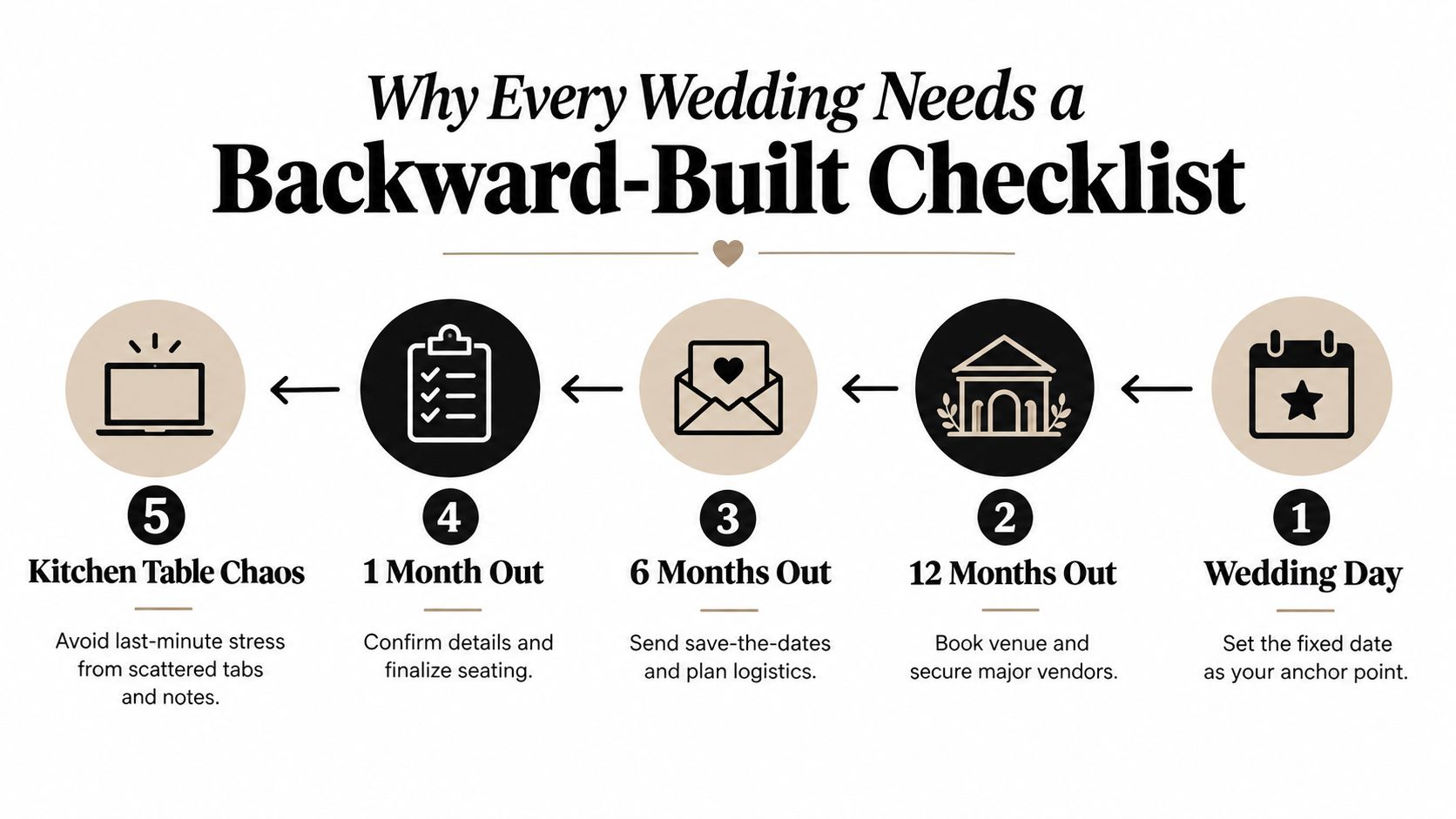
Why Every Wedding Needs a Backward-Built Checklist
A wedding date is fixed. Your planning tasks shouldn't float around it.
Most wedding timelines run across 12 to 18 months, largely because venues are often booked 12 to 18 months ahead, while photographers are commonly secured 9 to 12 months out. This wedding checklist guide reflects the practical reality: major decisions come first, while invitations, attire, and final logistics arrive later.
Consider a couple who gets engaged in spring and wants a popular summer Saturday the following year. If they start with flowers, stationery, or décor, they may feel productive without making progress on the decision that matters most. The venue determines the date, capacity, layout, catering rules, ceremony options, and often the preferred vendor list. The photographer is close behind, because the best date-specific availability disappears quickly.
Practical rule: Put the wedding date at the top of the page, then assign every task a deadline by counting backward.
Start with the decisions that unlock everything else
Your first planning block should answer four questions:
- What can we spend?
- How many people are we inviting?
- Which dates work?
- Which venue can hold the event?
Once those answers are stable, vendor conversations become specific rather than hypothetical. You can request accurate quotes, compare packages, and reject ideas that don't fit the space or budget.
The Knot reports that couples had an average 15-month engagement in 2023, spent an average of seven hours per week planning, and completed 91% of that planning online. The Knot's 2023 wedding data explains why a dated digital checklist matters. Your plan needs one source of truth, not a collection of browser tabs.
For couples coordinating a destination celebration, cultural details, or several formal events, a specialist resource such as this guide to a flawless Italian wedding can help turn broad inspiration into practical decisions. Use it for ideas, then place each decision on your backward calendar.
Setting the Foundation 12 or More Months Before
The first planning decisions determine whether the rest of the wedding stays manageable or becomes a chain of expensive compromises. Set the budget, guest count, preferred dates, and venue in that order.
Start with the four decisions that shape the rest of the plan
Write down the total amount available and name every contributor. Do not build the plan around assumptions such as “our parents will help” or “we'll work it out later.” Confirm who is paying, when funds will be available, and whether any contribution has conditions.
Use broad planning bands before you know every final price. This framework gives you a sensible starting point, not a fixed rule:
| Category | Percentage of Budget | Notes |
|---|---|---|
| Venue and catering | 40–50% | Usually the largest combined commitment |
| Photography and videography | 10–15% | Compare coverage, delivery, and usage terms |
| Attire and flowers | 10% | Include alterations, accessories, and delivery |
| Music, stationery, and transport | Remaining budget | Balance these against guest experience and logistics |
Keep a separate contingency line. Assigning every available amount to visible wedding elements leaves no room for alterations, delivery changes, overtime, or forgotten fees. A budget without breathing room is one of the foundational planning mistakes identified in this expert wedding-planning checklist.
Fix the guest count before you fall in love with a room
Guest count affects venue capacity, catering, rentals, transport, stationery, and formal photographs. Create a realistic first list with clear rules for plus-ones, children, colleagues, and distant relatives. That number will make venue quotes and capacity comparisons meaningful.
Choose two or three preferred dates rather than committing to one immediately. Flexibility gives you more room to compare venues while protecting the style and location you want. Do not announce a date publicly until the venue is contracted and the deposit terms are clear.
After booking the venue, check marriage licence requirements with the relevant local authority. Add every paperwork deadline to the same planning calendar. Requirements vary by location, so use the official authority instead of relying on a generic checklist.
Finish this foundation with a simple mood board. Include colour, formality, florals, attire, and lighting so vendors understand the direction without requiring every detail to be decided. Keep this guide to when wedding invitations should be sent beside the calendar when setting stationery deadlines.
Booking Vendors in the Right Order
Vendor research feels like shopping, but the challenge is sequencing. Book the suppliers whose availability controls the date first, then move to the teams that need confirmed logistics and guest information.
The venue and photographer belong at the front of the queue. Popular venues often fill 12 to 18 months ahead, and photographers are commonly booked 9 to 12 months out. This practical wedding-planning timeline places budget, guest count, date, and venue research at the beginning, followed by major vendor bookings.
Use lead time as your booking filter
| Vendor Category | Book This Many Months Before | Depends On |
|---|---|---|
| Venue | 12–18 | Budget, guest count, date |
| Photographer | 9–12 | Date, venue, coverage needs |
| Caterer | 8–10 | Venue, guest count, dietary needs |
| Florist | 8–10 | Venue, style, season, floral scope |
| Band or DJ | 8–10 | Date, venue, schedule, sound rules |
| Videographer | 4–6 | Date, venue, photography coordination |
| Cake | 4–6 | Guest count, menu, design |
| Transport | 4–6 | Locations, guest movements, timing |
| Attire and attendants' outfits | 4–6 | Wedding party, fittings, alterations |
| Stationery and signage | 4–6 | Guest information, design direction |
| Favours and small details | Final 3 months | Final guest count and budget |
The table distinguishes booking priority from the time required to complete the work. A florist may be booked months in advance, but the final floral quantities and installation details can wait until the guest count and floor plan are stable.
Book the caterer and music once the venue and date are confirmed. Caterers need the space, service rules, and approximate headcount to quote properly. Bands and DJs need to understand access, power, sound restrictions, and the event schedule before you compare offers.
Stationery and signage can wait until the wording, guest information, and design direction are settled. If the reception needs printed menus or other food-service materials, review specialist options such as Menu Printing for Restaurants & Weddings while you're finalising the printed pieces.
Ask better questions before signing
Every vendor call should establish availability, deliverables, payment dates, cancellation terms, overtime rules, setup requirements, and the person who will attend. Ask for these details in writing. A friendly conversation is useful, but a written contract protects the calendar.
Don't book a supplier solely because they respond quickly. Compare the service scope, not just the headline price. A cheaper package can become expensive if it excludes delivery, setup, editing, staffing, or the hours you assumed were included.
The Final Six-Week Countdown
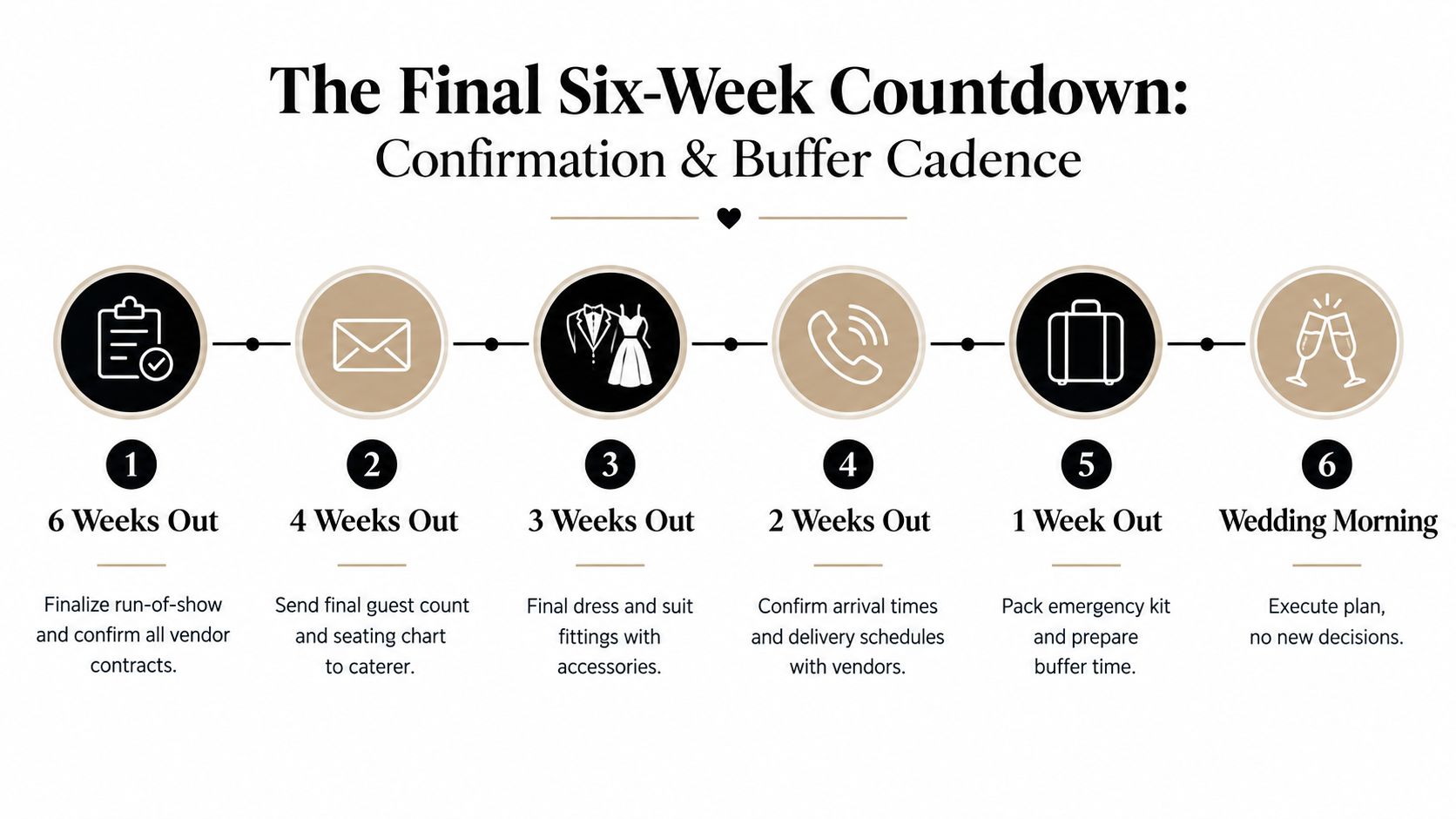
The final six weeks aren't for reopening major decisions. They're for confirming what you've already chosen, closing gaps, and giving someone else enough information to handle problems without interrupting you.
Six weeks through three weeks
At six weeks, finalise the run sheet, confirm the headcount with the venue and caterer, and lock the seating chart. Treat outstanding RSVPs as an active task, not a passive hope. At five weeks, contact non-responders, finalise the ceremony script with the officiant, and record every dietary requirement.
At four weeks, attend final dress and suit fittings, confirm transport and accommodation arrangements, and brief the master of ceremonies. The MC needs the actual order of events, names, pronunciation notes, and any announcements that must happen.
At three weeks, collect final invoices and confirm the working timeline with the photographer and videographer. Print stationery only after names, table assignments, menus, and ceremony wording have been checked by someone who wasn't involved in drafting them.
Two weeks through wedding morning
At two weeks, assemble the emergency kit, confirm the weather plan, and name the person responsible for wedding-day logistics. That person should have the vendor contact list, venue rules, timeline, seating chart, payment notes, and authority to make routine decisions.
At one week, distribute the final timeline to the wedding party and vendors, confirm hair and makeup start times, and rehearse the ceremony. Don't leave the schedule inside your own phone. Put it in the hands of the people who need to act on it.
The last three days are for steaming outfits, laying out rings and documents, checking packed boxes, and resting. Ask one question for every open item: Has this been confirmed in writing? If the answer is no, send the message now.
A useful final-week rhythm looks like this:
- Confirm: Get arrival times, deliveries, quantities, and responsibilities in writing.
- Delegate: Give one named person the authority to manage suppliers.
- Buffer: Protect time for delays, forgotten items, weather, and human error.
- Stop: Don't introduce new décor, schedule changes, or supplier swaps without a genuine need.
The wedding morning should contain execution, not decision-making.
Planning Pitfalls and How to Avoid Them
Most wedding failures are predictable. Audit your plan against the problems below, then fix the weak point before it becomes expensive.
| Pitfall | How to Avoid It |
|---|---|
| Booking the venue late | Shortlist three suitable venues before contacting other major vendors |
| Underestimating photographer availability | Contact photographers as soon as the venue date is secured |
| Letting the guest list expand after invitations | Set clear plus-one and children policies before invitations go out |
| Ignoring the weather plan | Confirm an indoor backup or tent option with the venue |
| Keeping only one vendor contact | Collect an assistant's number and a personal email |
| Assuming the Best Man will coordinate everything | Hire a day-of coordinator or appoint a named point person |
A late venue booking creates more than an inconvenient date. It can force compromises on capacity, ceremony layout, catering rules, accommodation, transport, and photography locations. The fix is simple but requires discipline: choose the venue before building the rest of the supplier team around an unconfirmed plan.
A growing guest list creates the same kind of pressure. Every additional guest affects food, furniture, stationery, favours, transport, and the room layout. Write the invitation rules before relatives start negotiating them individually.
Weather deserves its own line in the contract conversation. Outdoor ceremonies and receptions need a practical alternative, not a vague promise to “watch the forecast.” Ask who makes the call, when the decision happens, what the backup costs, and who moves the furniture.
For couples watching spending closely, these ideas for planning a budget-friendly wedding can help you separate meaningful priorities from details guests barely notice. The point isn't to eliminate every risk. It's to identify the risks early enough to choose a response.
Capturing Every Guest Photo After the Day
Your photographer creates the official record, but guests capture the moments that happen outside the planned coverage. A cousin's view from the dance floor, a grandparent's candid portrait, or a quiet preparation photo can add context that no formal gallery can provide.
The danger is fragmentation. Photos disappear into WhatsApp threads, Instagram messages, camera rolls, and phones that nobody checks again. Build the collection process before the reception begins.

Create one upload route
Set up a branded upload page with your names, colours, and a short welcome message. Print a QR code and place it beside the guest book, bar, and dance floor. Guests should understand the request in seconds: scan, choose photos or videos, and upload from the phone they already have.
A platform such as EventUploader lets an organiser create a branded upload page, share a link or QR code, collect uploads without requiring guests to install an app, and export the event media from one dashboard. You can also use a shared cloud folder or another gallery service, provided the route is clear and guests know where their files are going.
Place the upload invitation into the thank-you message sent after the wedding. Present it as a way for guests to give the couple their perspective of the day, not as administrative work. The guidance in this wedding guest photo upload guide can help you prepare the sign and message.
Set the upload window for three months so guests have time to find images after travel, work, and everyday life resume. Nominate one sibling or close friend to send one reminder at the two-week mark. That keeps the process organised without turning your family group chat into a campaign.
After the window closes, download the files into a shared folder organised by guest or upload source. Merge that collection with the photographer's gallery, then create a final archive with clear filenames and a backup. The result is a fuller record without asking the couple to chase every individual photograph.
The visual setup can be simple, but the wording should be warm. Tell guests that blurry, funny, unplanned, and imperfect images are welcome. Those are often the photographs that bring the day back most vividly.
Here's a short visual guide to the guest-upload workflow:
Your Printable Wedding To Do List and Quick Answers
A useful printable list should reduce thinking, not repeat the entire internet. Keep one page divided into chronological bands, with a checkbox beside every task and room for vendor contacts, deposits, and balance-due dates.
The compact checklist
- 12 or more months: Set the budget, agree the guest count, choose preferred dates, book the venue, and check marriage licence requirements.
- 9 months: Book the photographer, caterer, florist, and music. Confirm the rain plan and begin the design direction.
- 6 months: Order attire, book transport, confirm accommodation information, arrange videography, and prepare stationery wording.
- 3 months: Send invitations if they aren't already out, finalise ceremony details, confirm décor, and review outstanding RSVPs.
- 6 weeks: Lock the run sheet, confirm guest numbers, finalise seating, record dietary needs, and brief the MC.
- 1 week: Distribute the timeline, confirm supplier arrivals, pack the emergency kit, and rehearse the ceremony.
- Wedding day: Give the schedule to the named point person, keep rings and documents together, and make no unnecessary new decisions.
- Post-wedding: Send thanks, share the guest upload route, collect media, download the archive, and back it up.
Print wedding signs for your upload table and guest areas, then keep your main checklist on a fridge, clipboard, or shared Notes folder.
Quick answers from a working planner
Does a wedding planner justify the cost?
A planner earns their place when the logistics are complex, the venue has strict rules, or nobody close to you can manage suppliers on the day. For a simpler wedding, a day-of coordinator may provide the practical support without taking over the whole planning process.
How does a destination ceremony change the timeline?
Start earlier for travel, accommodation, legal paperwork, and guest communication. Keep the same backward structure, but place location-specific deadlines beside the main wedding date.
What happens if a vendor cancels at the last minute?
Use the replacement and cancellation terms in the contract, then contact the venue and coordinator for trusted alternatives. Your point person should handle the calls while you stay focused on the ceremony and guests.
How many guest photos should you expect?
There isn't a reliable universal number. Make uploading easy, explain what you want, and invite both photos and videos so guests contribute different views of the day.
Does the list change for a second marriage?
The sequence stays broadly the same, but the guest experience and ceremony may be more personalised. Keep the decisions that affect suppliers and legal requirements at the top, then remove traditions that don't matter to you.
EventUploader gives you a branded upload page, one shareable link or QR code, and a central place for guests to send wedding photos and videos without an app or account. Set up your guest-photo workflow before the reception and invite EventUploader to help keep every perspective of the day together.