8 Unique Ideas for Weddings on a Budget
Discover unique ideas for weddings on a budget, from DIY décor and guest photo galleries to affordable venues, catering, and entertainment.

A memorable wedding doesn't require a large vendor package. In many cases, the most effective savings come from changing the format of the celebration rather than finding cheaper versions of every traditional service. A smaller guest list, a venue with built-in character, a shared meal, or a single flowing event can reduce complexity while giving guests more opportunities to participate.
That matters because guest count often drives the budget more than decorative details. The Knot's 2026 Real Weddings Study found that weddings with 50 guests or fewer averaged $15,000, compared with $42,000 for weddings with more than 100 guests. The same study reported an overall average U.S. wedding cost of $34,200.
The following unique ideas for weddings on a budget focus on redesigning the guest experience around shared contributions, simpler logistics, and guest-generated memories. You'll find practical options for photography, food, venues, décor, timelines, entertainment, and archiving. Choose the ideas that protect what you most want to remember, and cut the parts that add cost without adding meaning.
EventUploader can support that approach as an optional memory tool. Couples can create a branded upload page, then invite guests to share photos and videos through one link or a printable QR code, without requiring an app or account.
Table of Contents
- 1. Digital Photo Collection via QR Codes
- 2. Potluck-Style Catering With Family Contributions
- 3. Intimate Micro-Weddings With Scaled Simplicity
- 4. DIY Décor and Styling Using Nature and Personal Items
- 5. Alternative Venue Selection With Non-Traditional Spaces
- 6. Simplified Wedding Day Timeline and Single-Event Format
- 7. DIY Entertainment and Music Curation
- 8. Group Photo Collection and Guest Memory Archiving
- 8 Budget-Friendly Wedding Ideas Comparison
- Build the Wedding Around What You Want to Remember
1. Digital Photo Collection via QR Codes
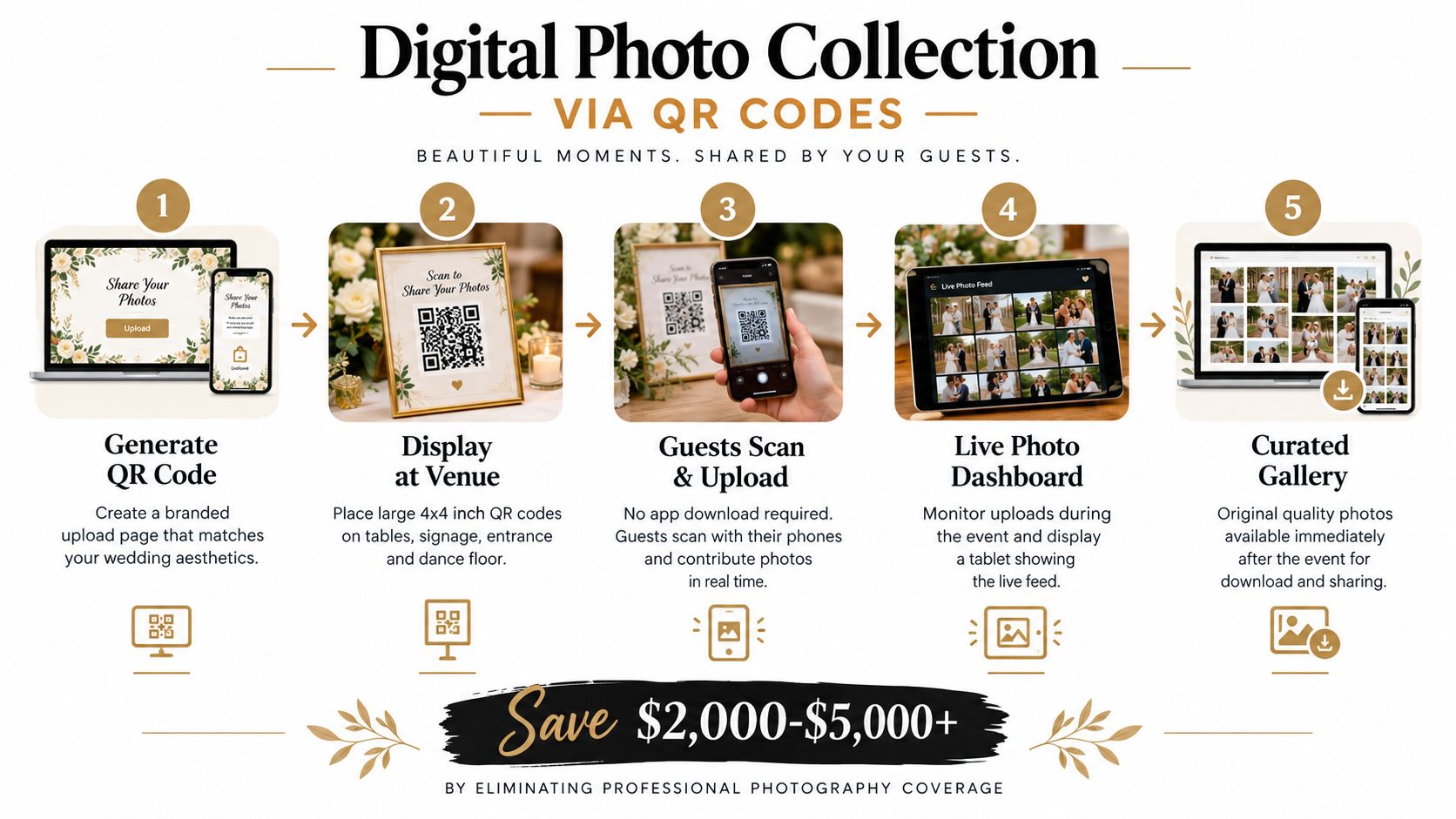
Guest photography works best when you make participation obvious and effortless. Place a large QR code on the welcome sign, reception tables, ceremony exit, and near the dance floor. Guests can scan it with their phones and upload images to one shared gallery instead of scattering them across text threads, social platforms, and individual camera rolls.
Use direct signage such as “Scan to share your memories” rather than assuming guests will understand what the code does. A tablet displaying the live gallery near the entrance or bar can also show people that uploads are arriving, which gives them a reason to contribute during the celebration.
EventUploader's guide to QR code photo albums explains the basic flow for setting up this kind of collection. Test the upload page before the wedding, check the venue's Wi-Fi, and keep a mobile hotspot available if connectivity is uncertain.
Practical rule: A QR code only saves effort when guests can see it, understand it, and scan it quickly.
Make the collection feel intentional
Use a branded welcome message that tells guests what kinds of moments you want. Ask for candid reactions, preparation photos, table details, dancing, and pictures of people who might not appear in the formal photography. You can also encourage a shared hashtag, but don't make social media the only route because some guests may prefer a private upload.
Assign one trusted person to monitor the gallery and answer basic questions. Print the code at a generous size, place it at eye level where possible, and include a short instruction beside it. Guest images won't replace every role of a professional photographer, especially for portraits, ceremony coverage, or difficult lighting. They can, however, add viewpoints and spontaneous moments that a single photographer can't capture at once.
2. Potluck-Style Catering With Family Contributions
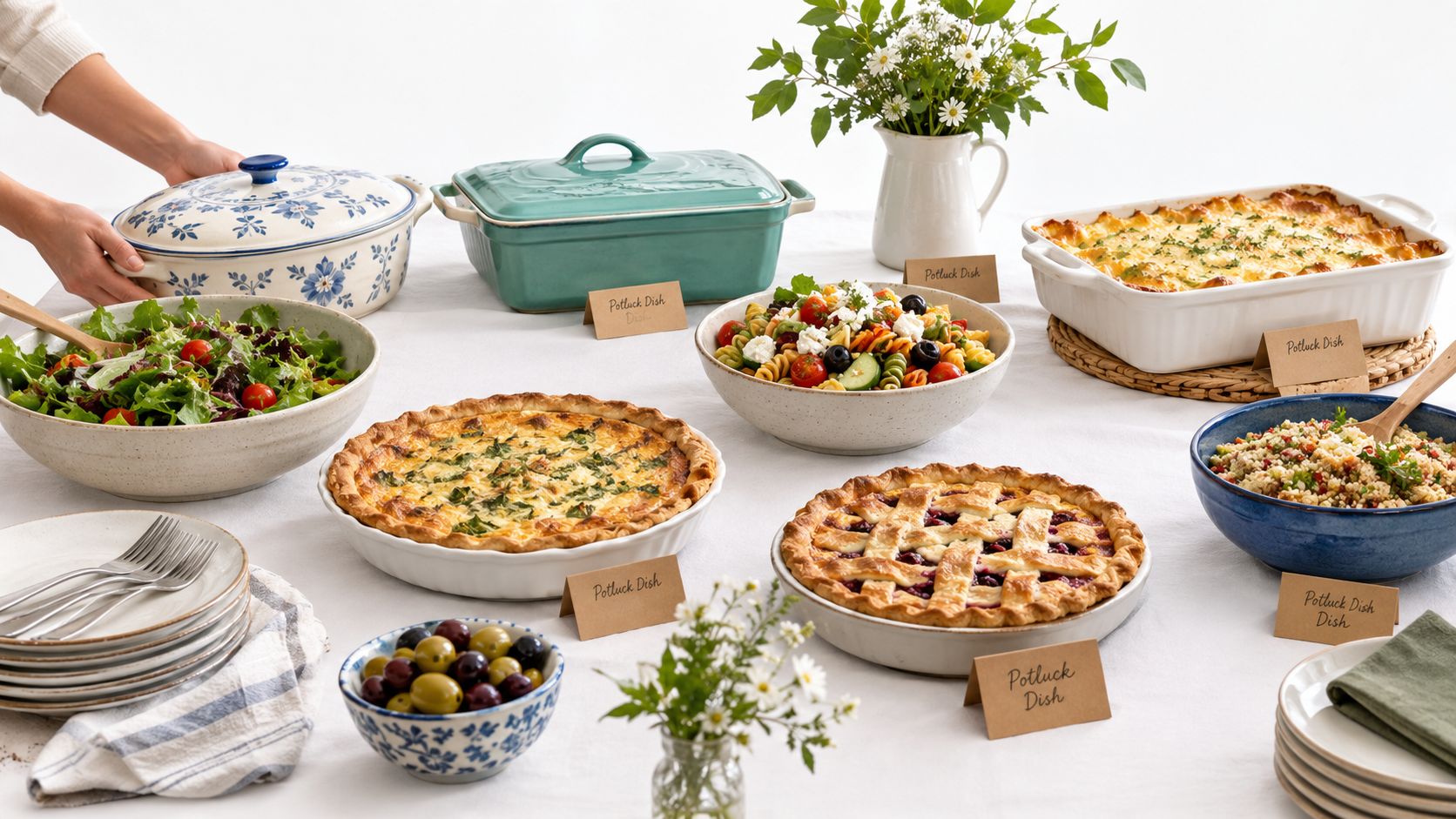
A collaborative meal can feel more personal than a standardized menu, but it needs stronger coordination than just asking relatives to bring food. Start with a sign-up organized by category, including appetizers, main dishes, sides, desserts, and drinks. Ask contributors to describe ingredients and allergens, and label each dish at the serving table.
This format suits backyard weddings, community halls, and family-centered celebrations particularly well. A multicultural wedding can turn the meal into a living family story, with each contribution connected to a household, region, or tradition. Photograph contributors beside their dishes and add those images to the shared wedding gallery so the food becomes part of the record.
The trade-off is responsibility. Homemade food may arrive at different temperatures, in different serving containers, and at different times. Without a coordinator, the couple may spend the reception arranging trays instead of speaking with guests.
Keep the kitchen from becoming the reception desk
Choose food that can be prepared ahead, transported safely, and reheated without last-minute work. Borrow or rent serving tables, chafing dishes, beverage dispensers, and utensils before the event. Assign one person to manage food setup, replenishment, labels, and cleanup. That person shouldn't be the couple.
A hybrid approach often works better than insisting that every dish be homemade. You might ask family members to provide sides and desserts while hiring one professional caterer to handle a main protein, food safety, or service coordination. That preserves the shared-contribution idea without making the entire meal dependent on volunteer timing.
Give contributors clear instructions about portion sizes, presentation, serving tools, and arrival windows. The goal isn't a chaotic buffet. It's a meal with visible human involvement and enough structure that guests can enjoy it.
3. Intimate Micro-Weddings With Scaled Simplicity
A smaller wedding can feel more personal when you redesign the experience around the people who attend. The Knot's wedding cost data shows how strongly guest count affects spending, with weddings of 50 guests or fewer averaging $15,000 and weddings with more than 100 guests averaging $42,000. Fewer guests can also let you direct money toward one shared experience instead of spreading it across every wedding element.
Choose a setting that supports conversation, such as a backyard, park pavilion, private home, or restaurant room. A brunch or afternoon gathering can replace a formal evening production. An elopement-plus format can pair a private ceremony with a small dinner. Families living in different cities might hold separate celebrations rather than asking everyone to travel to one expensive destination.
Spend deeply in one place
Use the smaller guest list to fund one memorable priority. That could be exceptional food, a musician you love, a meaningful activity, or a venue with natural beauty. Keep the remaining choices simple so the budget supports the moment guests will remember.
Remove traditions that do not fit your relationship. Formal entrances, elaborate favors, and a large wedding party may add cost without adding meaning. Existing landscaping and natural light can provide the setting. Conversation, lawn games, a guided tasting, or a short activity connected to your relationship can replace formal entertainment while giving guests a way to participate.
Photography benefits from the same focus. Hire coverage for the ceremony and portraits, then let guests document the informal parts of the day. A shared collection through EventUploader can gather those guest photos afterward, preserving candid memories without paying for full-day professional coverage. Coordinate group photos efficiently so everyone is included without turning the gathering into a long production.
The main risk is leaving out people you want present. A reduced guest list saves money only when it feels deliberate rather than painful. Decide who belongs in the room, then give others a meaningful role through a message, recorded toast, shared photo collection, or separate gathering.
4. DIY Décor and Styling Using Nature and Personal Items
DIY décor saves money only when you control the scope. Choose a limited visual system, such as two or three main colors, one type of container, and a small number of repeatable elements. A consistent palette makes grocery-store flowers, thrifted vessels, handwritten signs, and borrowed linens look coordinated rather than accidental.
Natural settings can do much of the visual work. Branches, leaves, stones, garden plants, and seasonal flowers can create texture without filling every surface. Personal items add meaning that rented décor can't provide, including family photographs, inherited objects, books, ceramics, or fabric with a story behind it.
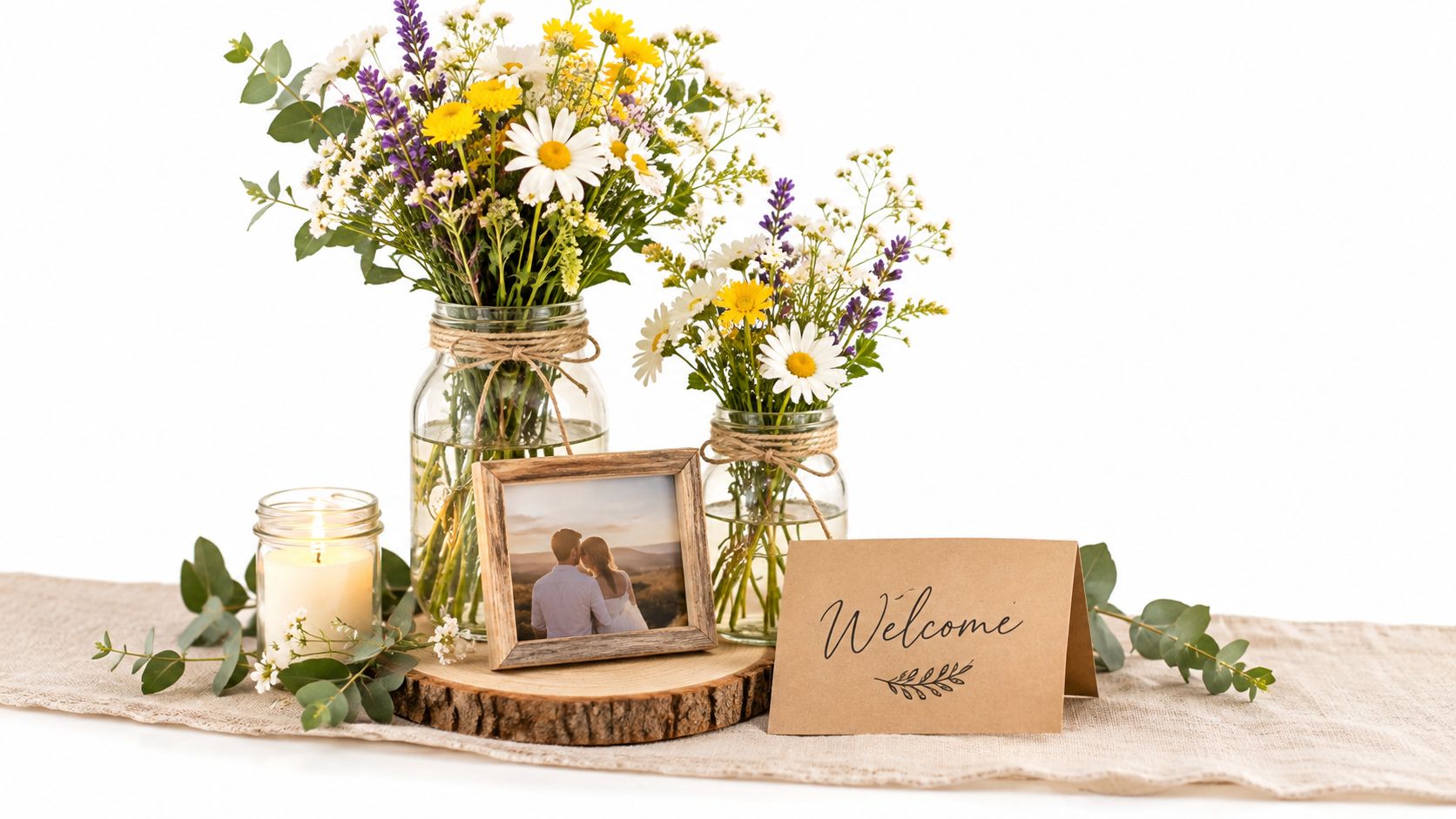
Start early enough to test the design, but don't create a craft project for every guest-facing surface. Make one centerpiece prototype, photograph it in the actual type of light you'll have, and calculate how long it takes to reproduce. That test will show whether the idea is affordable or merely shifting the cost into your time.
Design for setup and removal
Use neutral linens to let smaller floral arrangements stand out. String lights and candles can change the atmosphere more efficiently than large decorative installations, but confirm venue rules and fire-safety requirements first. Gather friends for a defined craft afternoon with a short list of tasks, not an open-ended promise to “help with décor.”
Store flowers and finished pieces safely, and assign separate teams for setup and breakdown. Photograph the process and finished details for the EventUploader gallery, including the people who made them. A homemade seating chart means more when guests can see the hands and stories behind it.
Be cautious with complicated installations, fragile hanging elements, and décor that requires specialist tools. If a design takes several people to assemble but disappears from view once guests arrive, it may not deserve the budget or stress.
5. Alternative Venue Selection With Non-Traditional Spaces
The most useful low-cost venue is often the one that already looks complete. A botanical garden, farm, beach, lakeside area, vineyard, family property, public park, community center, or church hall may provide scenery, seating, or a flexible layout without requiring a full decorative build.
A venue outside the standard wedding circuit can also shape the celebration in a more personal direction. A family backyard supports a relaxed meal. A park encourages an outdoor ceremony and picnic reception. A restaurant room may provide food service, tables, lighting, and staff as part of one arrangement.
Don't compare rental prices alone. A cheap space can become expensive if you need to add toilets, power, furniture, lighting, tents, insurance, permits, cleanup, and transportation. Ask for a complete list of included services and restrictions before you fall in love with the scenery.
Visit at the actual wedding conditions
Walk through the space during the season and time of day you expect to use it. Check parking, accessibility, bathrooms, electricity, water, cell service, Wi-Fi, setup windows, breakdown requirements, and weather procedures. Identify where guests will stand, where food will be served, and where the photographer can work without blocking movement.
A backup plan isn't optional for an outdoor event. It might be an indoor room, a tent, umbrellas, or a clear decision to move the ceremony and meal into another area. Confirm permits and liability requirements early, and make sure every vendor understands the venue's access rules.
Choose a space that reduces the number of things you must bring in. Natural beauty helps, but operational simplicity protects the guest experience.
6. Simplified Wedding Day Timeline and Single-Event Format
Combining the ceremony, meal, and reception into one continuous gathering can remove expensive gaps between separate events. Guests arrive, settle into the ceremony space, move naturally toward drinks or appetizers, and continue into the meal without a long transfer or room reset.
One workable format might begin with guest arrival, followed by a short ceremony, immediate refreshments, dinner, and informal dancing or conversation. A brunch celebration or afternoon tea can offer the same sense of occasion without requiring a late-night production. A garden wedding can keep the ceremony and meal in one location, using the same tables and décor throughout.
Build the movement before you book the room
Choose a venue that supports the full sequence. Guests should understand where to go next without relying on repeated announcements. Use a simple printed program or signs to mark the transition, and assign one point person to manage timing so the couple isn't checking the clock.
Keep the ceremony length appropriate for the format and provide shade, seating, water, or shelter during any wait. Heavy appetizers may suit a quick transition better than food that requires a formal reset. If the ceremony and meal use the same space, plan how guests will move while staff or volunteers make any necessary changes.
The simplest timeline is not the shortest one. It's the one with the fewest moments where guests wonder what happens next.
Communicate the schedule clearly in the invitation. Guests need to know whether they're attending one uninterrupted event or moving between locations. A compressed timeline can feel warm and energetic, but it can also feel rushed if you try to fit every traditional element into fewer hours. Remove rituals that don't matter instead of squeezing them into the gaps.
7. DIY Entertainment and Music Curation
A curated playlist can make the reception sound more like you than a generic event package. Organize music by ceremony, arrival, cocktails, dinner, dancing, and closing. Include songs connected to your relationship and guests, but avoid making the playlist so personal that people can't dance or relax.
You'll need more than a phone and a speaker. Test the full system at the venue, including volume, power, Bluetooth connections, microphone use, and transitions. Appoint a tech-savvy friend to manage playback and keep a backup playlist available in case the reception runs longer than planned.
A friend who plays acoustic music can provide a focused live moment without committing to a full band. A karaoke set, simple photo booth, wish book, or video-message station can turn guests from spectators into participants. The best entertainment choices give people something to do without forcing them into a performance.
For practical planning ideas, use these wedding reception entertainment suggestions as a starting point, then adapt them to the room and the people attending.
Give volunteers a defined brief
If a friend is acting as MC, provide the timeline, announcement wording, music cues, and a clear handoff plan. If someone manages the photo booth, give them supplies and instructions before guests arrive. Don't assume a talented friend automatically wants to work throughout the entire reception.
DIY entertainment works when the equipment is reliable and the responsibilities are visible. It fails when the couple becomes the sound engineer, DJ, MC, and activity coordinator. Pay for specialist help where a mistake would interrupt the ceremony or leave guests without essential information.
8. Group Photo Collection and Guest Memory Archiving
A shared gallery becomes more valuable when you plan it as an archive, not just a place to dump photos. Create the upload page before the wedding, customize the welcome message, and test it with the wedding party. Then print the same QR code for the entrance, tables, guest book area, and any other place where people naturally pause.
The collection can cover the whole wedding weekend, including preparation, the ceremony, the meal, dancing, and informal gatherings. Guests often photograph different people and moments from the official coverage, especially relatives sitting at distant tables or spontaneous conversations happening outside the main schedule.
EventUploader's free wedding guest photo upload option can support a centralized collection through a link or QR code. Guests can upload from their phones without downloading an app, and the couple can use the resulting gallery as a shared record rather than hunting through separate conversations.
Plan the post-wedding handoff
Assign a tech-comfortable person to answer questions during the event and encourage uploads without interrupting the celebration. Keep a backup connection available, and follow up with guests afterward for photos they didn't upload on the day. Decide whether the gallery should be private or shareable based on guest preferences.
Export the collection after the wedding while everyone still remembers who and what appears in each image. Use selected photos for thank-you notes, anniversary updates, or a family archive. If a professional photographer is also involved, give them access to the guest collection only if both sides are comfortable with that arrangement.
The archive is strongest when it includes the contributors, not just the finished decorations. Ask guests to capture one another, the people behind the food, the setup, the quiet pauses, and the moments the couple misses. That shared record is one of the most personal ways to make a budget wedding feel expansive.
8 Budget-Friendly Wedding Ideas Comparison
| Item | 🔄 Implementation Complexity | ⚡ Resource Requirements | 📊 Expected Outcomes | 💡 Ideal Use Cases | ⭐ Key Advantages |
|---|---|---|---|---|---|
| Digital Photo Collection via QR Codes | Low, quick setup (5–10 min); test WiFi and print QR signs. | Guests' smartphones, WiFi/hotspot, tablet for live feed, EventUploader account. | Real-time multi-angle photo feed; volume high, quality variable. | Large or multi-location weddings, guest-engagement focused events, destination/backyard. | Major photography cost savings ($2k–5k+); immediate access; collaborative guest contributions. |
| Potluck-Style Catering with Family Contributions | Medium, requires detailed sign-up and coordination; day-of setup manager needed. | Many volunteer cooks, kitchen/oven access, serving equipment, coordination tools (spreadsheet/app). | Significantly lower per-person food cost; menu personal but inconsistent risk. | Family-centric celebrations, cultural/traditional menus, backyard weddings. | Dramatic catering savings ($2k–4k+); personal/nostalgic menu; guest involvement. |
| Intimate Micro-Weddings with Scaled Simplicity | Low, simpler logistics, smaller guest list decisions are key. | Smaller venue or home, limited vendors (shorter photographer hours), focused budget per guest. | 50–70% total budget reduction; higher quality-to-cost experiences for guests. | Couples prioritizing intimacy, elopements, destination micro-events. | Large overall savings; easier coordination; more meaningful guest interactions. |
| DIY Décor and Styling Using Nature and Personal Items | Medium–High, time-intensive crafting and coordinated setup. | Craft supplies, bulk flowers, volunteers, storage/cool space, tools for setup. | Highly personalized aesthetics; saves $1.5k–3.5k but time investment high. | Creative/crafty couples, sustainable weddings, rustic/boho themes. | Unique, sustainable décor; strong personal storytelling; cost reduction on florals/decor. |
| Alternative Venue Selection: Non-Traditional Spaces | Medium, requires permits, contingency planning, and logistics (parking, restrooms). | Permit fees, possible tent/portable restrooms, transport/parking planning, vendor coordination. | Lower venue costs ($1.5k–3.5k saved); built-in scenic backdrops; weather-dependent. | Outdoor lovers, budget-conscious couples, those seeking distinctive backdrops. | Reduced rental fees; natural decor reduces setup; memorable/instagrammable settings. |
| Simplified Wedding Day Timeline and Single-Event Format | Low, streamlined timing and single-venue flow; clear timeline planning. | Single venue for full event, fewer vendor hours, concise timeline management. | Shorter event (3–4 hrs); saves $1k–2k via reduced vendor time; continuous guest experience. | Couples wanting low-stress, efficient celebrations; small-to-medium gatherings. | Fewer vendor fees; simpler logistics; cohesive guest experience and easier photography. |
| DIY Entertainment and Music Curation | Low–Medium, playlist planning and on-site tech management required. | Speakers/sound system, playlists (Spotify/Apple), tech-savvy friend or volunteer, backup devices. | Personalized soundtrack; saves $1.5k–3.5k; variable sound quality and transitions. | Casual receptions, music-savvy couples, small/DIY-friendly gatherings. | Cost-effective personalization; interactive guest participation; flexible music choices. |
| Group Photo Collection and Guest Memory Archiving | Low, platform setup and QR/link creation; curation after event required. | Guests' phones, WiFi/hotspot, EventUploader or similar platform, tablet for uploads. | Centralized, searchable archive of original-quality photos; reduces fragmentation; quality varies. | Any wedding seeking consolidated memories, multi-day events, remote-family inclusion. | Permanent, organized gallery; immediate access; major photography cost savings ($2k–5k+). |
Build the Wedding Around What You Want to Remember
You don't need all eight ideas. Combining too many alternative systems can create a different kind of expense, measured in coordination, favors, storage, transport, and stress. Pick one structural saving first, then add one or two personal touches that fit the way your guests behave.
A smaller guest list can reduce food, seating, venue, and transportation demands, while an alternative venue can provide atmosphere without a large décor build. A single-event timeline can simplify rentals and staffing. These choices work best when you make them early, because they influence every other decision.
Then choose the elements that create meaning rather than merely visual novelty. A shared family meal can be more memorable than a professionally styled buffet. A friend-led music set may matter more than elaborate entertainment. Family photographs, handwritten menus, a personal ceremony, or an activity tied to your relationship can give the day a stronger identity than expensive centerpieces.
Be candid about the trade-offs. Guest-led photography won't provide the same guaranteed portrait coverage as a professional photographer. DIY décor requires labor and organization. A potluck requires food-safety planning and a reliable coordinator. An outdoor venue needs a weather plan. A compressed timeline can feel rushed if you try to preserve every traditional event.
Protect the moments you'll regret losing. If formal portraits are very important, budget for a photographer and use guest uploads to supplement that coverage. If food is central to your celebration, spend on coordination and ingredients while simplifying décor. If dancing is essential, prioritize sound reliability and a capable music lead instead of spreading the budget across several entertainment extras.
Your memory plan should be specific. Set up and test the EventUploader upload page before the wedding. Print a QR code large enough to scan easily, display it in several visible locations, and add instructions that explain exactly what guests should do. Confirm the venue's connectivity, keep a backup hotspot available, and assign someone to encourage uploads and resolve simple problems.
After the celebration, curate the gallery while names, conversations, and context are fresh. Invite guests to add forgotten images, organize the strongest photos, and share the finished collection with the people who helped create it. A smaller budget can produce a richer record when guests actively contribute their perspectives.
EventUploader gives couples a branded upload page and one link or printable QR code for collecting guest photos and videos without an app or account. Use it to turn your wedding guests into contributors, then visit EventUploader to create a shared gallery for the celebration.