8 Creative Group Photos Ideas for Events in 2026
Explore 8 creative group photos ideas for weddings, parties, and milestones, with setup tips for stair-step, overhead, and silhouette shots.

Twenty guests pile onto the venue steps while someone yells to squeeze closer. Two cousins in the back blink, and the front row hides the shorter guests. You leave with a file nobody wants on the invite.
Most group photos fail for three plain reasons, hidden faces, a flat line, and a rushed setup. A Cornell computer-vision study identified 35 visual features for photographs containing more than one face, compared with 29 for a single person. Extra group factors included spatial relationships among faces, distances between faces, consistent expressions, and individual face poses. Faces pull attention, so arrangement decides whether the picture looks finished.
The same line of work ranked open eyes and a shared gaze as especially influential. Central placement, little occlusion, and a smile also helped. I stage people in layers or arcs, stagger the heads, and aim every eye at one point. I take several frames so one blink does not waste the setup. You do not need a new lens to fix it.
These eight creative group photos ideas are written for a guest group you can finish in under five minutes. Each note covers headcount, space or gear, who goes where, and when the idea fails. Use them at weddings, birthdays, offsites, and festivals, then collect the rest of the day's photos so this pose is not the only record.
Table of Contents
- 1. Tiered Stair-Step Arrangement
- 2. Circular Huddle from Above
- 3. Synchronized Group Jump
- 4. Golden Hour Silhouette
- 5. Arm's-Length Selfie Crowd Shot
- 6. Overhead Flat-Lay Group Arrangement
- 7. Leading-Lines Corridor or Staircase Composition
- 8. Cinematic Tableau with Varied Poses
- How the eight creative group photo ideas compare
- Turn One Great Group Shot into a Full Event Record
1. Tiered Stair-Step Arrangement
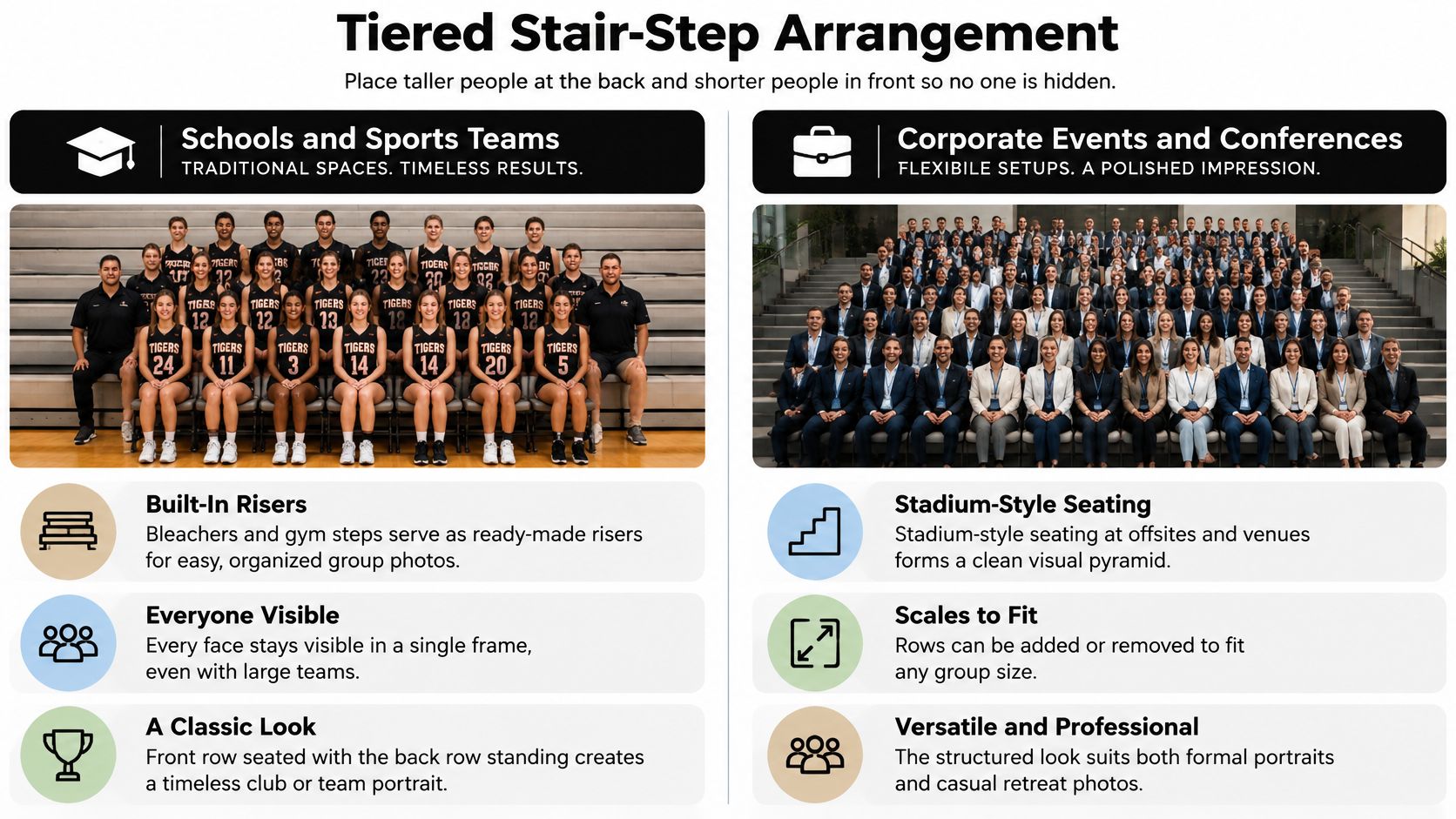
Reach for stairs, bleachers, or a low wall when you have 12 to 60 people. A flat lawn with a big team hides the back row. Risers build a pyramid so every face clears the shoulders in front. Sports clubs and school teams already know this. Conference groups on stadium seating do too.
The spacing is easier to see than to describe.
Who stands where
Put the tallest people on the highest step and shorter guests in front. Reversing that buries faces. Seat the front row at slight angles, not shoulder to shoulder, so you don't get a fence of bodies. Stand a little above the top row, on one extra step or a chair you have already tested. A phone at chest height from the grass looks up noses.
Say it is a club photo on stadium seats. The back row stands, the middle row uses solid seat backs only, and the front row sits on the tread. Check wobble before anyone climbs. One person reads names so stragglers aren't still walking in.
You can finish in under five minutes if the stairs are clear before the group arrives.
- Clear the landing first: Bags and drinks come off the steps so nobody trips.
- Lean the back row in: A small lean shows chins without stacking heads.
- Burst three frames: Keep the frame with open eyes, not the first click.
Anyone who would rather sit takes the front tread. More reunion layouts sit in this family reunion photo guide.
2. Circular Huddle from Above
A bridal party on a stair landing, or a festival cluster under a balcony, wants a ring, not a row. Small groups work best, roughly 4 to 10 people. Beyond that range the circle stretches into a loose donut with a hole in the middle and faces shrink to thumbnails. You need a safe high point: a landing, a balcony rail, or a monopod held overhead. Skip drones when the ceiling is low or the crowd is dense.
Practical rule: Keep heads closer than feels natural. If you can see floor between shoulders, step in and reshoot.
A 2026 survey of 2,000 adults found that 83% treated fitting everyone in the frame as a major priority, 77% wanted everyone looking at the camera, and 75% wanted a natural moment. Blinks and people looking away ranked among the usual reasons for a retake. An overhead huddle hits all three priorities if you direct it, because every face points the same way and the camera sees everyone at once.
Faces angle up, or inward toward one person in the center if the group wants a private toast. Hands rest on shoulders only when everyone has agreed to contact. Count down, then hold the shutter in a short burst.
I prefer a phone on a monopod over leaning over a rail, because the rail shot depends on architecture you cannot move. The trade-off is intimacy versus coverage. A huddle will not hold a 40-person department, and it fails in harsh noon sun that throws hard shadows under brows. In open shade it reads as one unit in about three minutes.
3. Synchronized Group Jump
The jump is a celebration, not a portrait system. It suits 8 to 20 people who can leave the ground together, on grass, a wide step, or a clear dance floor. You want a wide phone lens, burst mode, and a spot with nothing overhead. Wedding parties on venue steps and teams after a milestone are the usual clients. It looks dead if half the group is still on the way up.
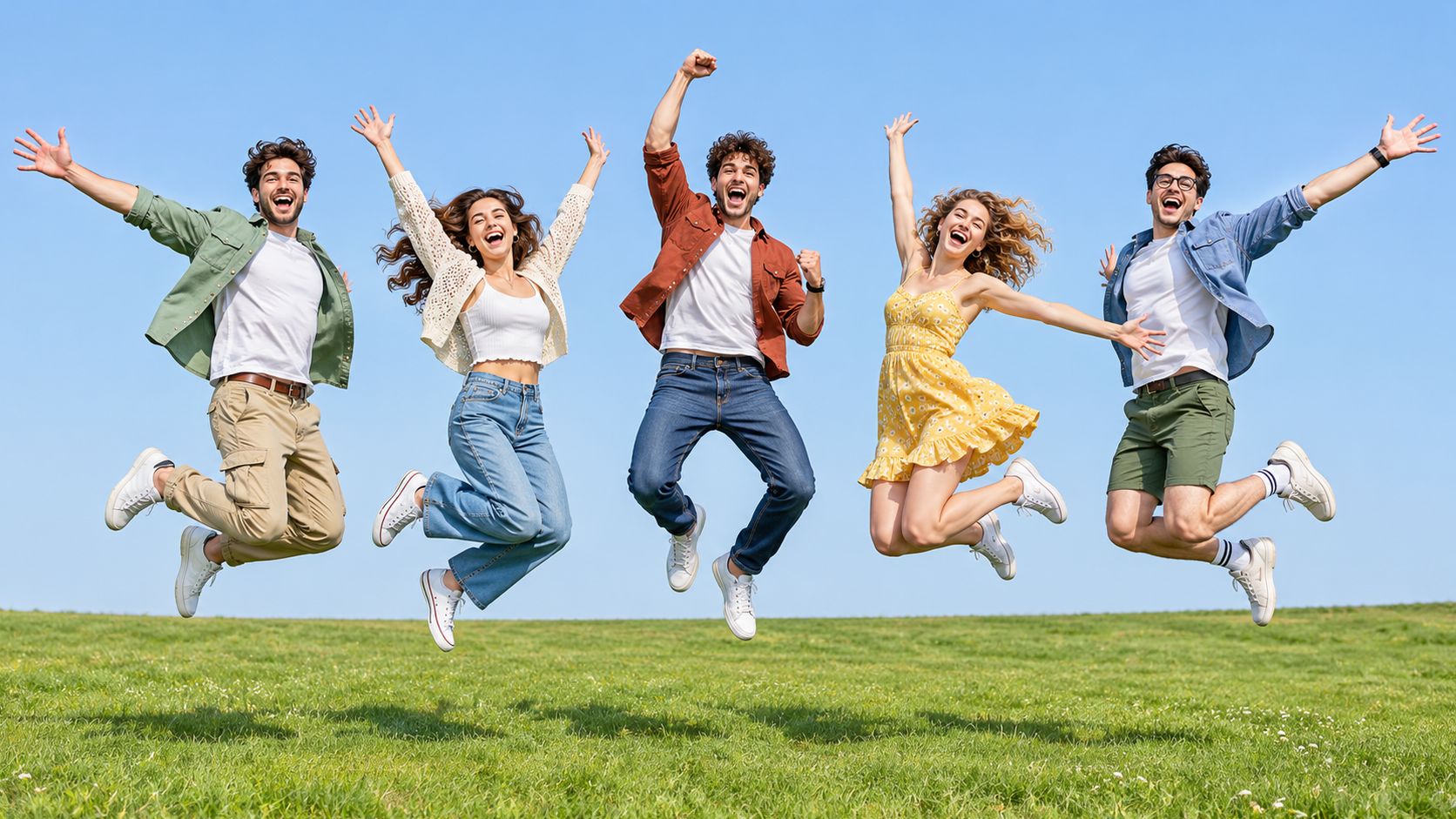
Count one, two, three out loud and shoot the peak, not the landing. Do one test jump for framing before the actual set. Ask people to pause a beat after they land so the next frame isn't a pile of bent knees. If the group is airborne and cropped, you were too tight.
This idea fails people who can't jump, and forcing it makes a worse photo than a still group. Guidance on group poses recommends treating wheelchair users as central participants rather than parking them at the edge, offering seated or standing options, using step-free ground, and asking how support workers prefer to appear. I keep a second setup ready, the same lineup with a cheer and lifted hands, so nobody has to perform a jump to belong in the frame. That alternate still finishes inside five minutes.
4. Golden Hour Silhouette
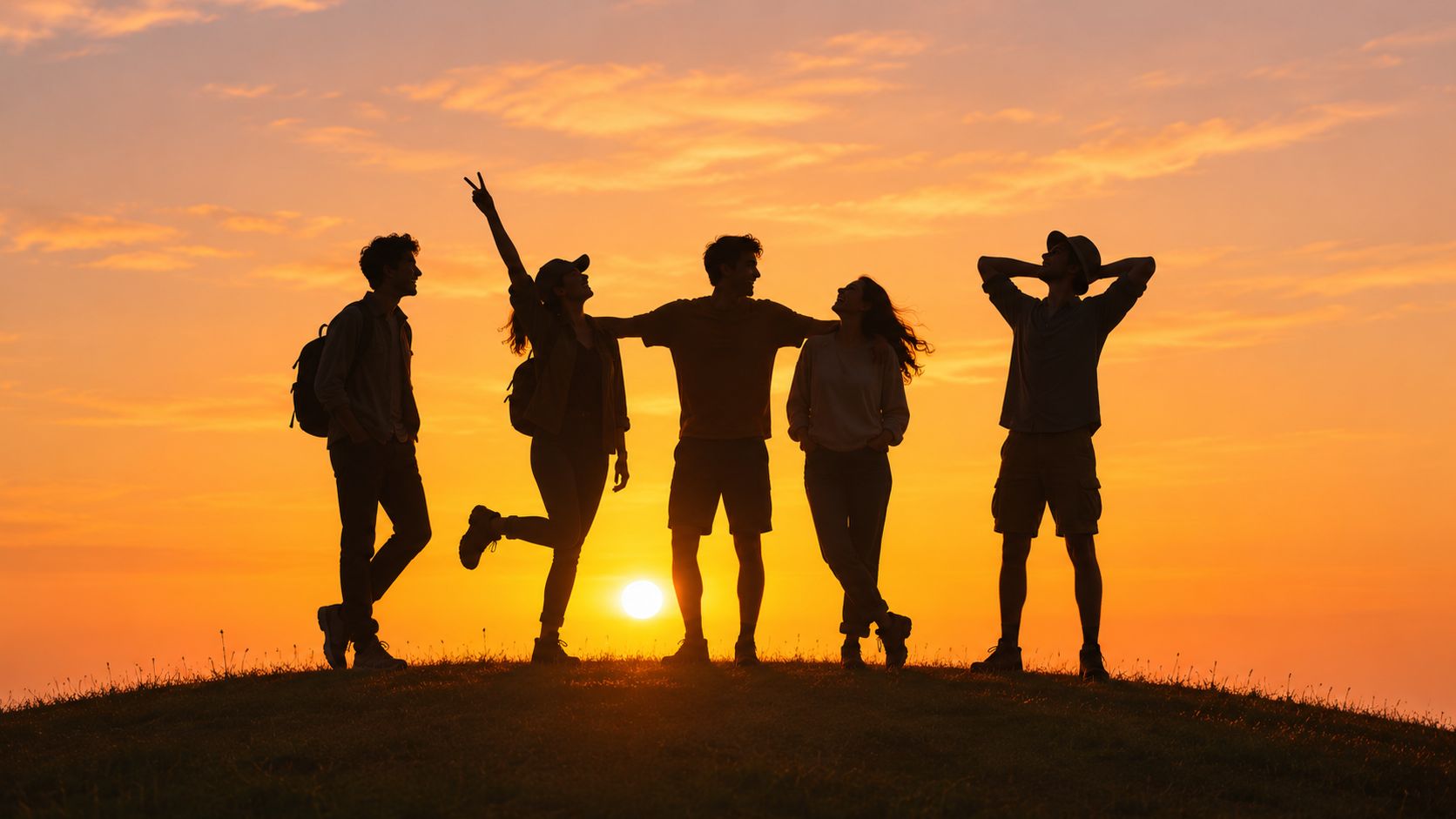
Stand the group between you and a low sun, or a bright window, and the outline does the work. Faces disappear on purpose. Posture, linked arms, and a gap between bodies become the subject. It fits couples through groups of about 12 on a beach, a hill, or the end of a pier. Past that, silhouettes merge into one blob.
Expose for the sky
Tap the bright sky, then lock exposure so the group falls into shadow. If you tap a face, the software brightens the people and kills the glow. A CVPR paper on smartphone photography assembled the SPAQ set of 11,125 photographs from 66 smartphones, scored for brightness, color, contrast, noise, and sharpness. Megapixels will not rescue a face that is both backlit and meant to be a shape. Leave digital zoom alone, shoot at the phone's highest native size, and keep extra sky in the frame for a later crop.
Place the sun just behind the heads for a thin rim. Space elbows so each person reads as a separate shape. A raised bouquet, a lifted diploma, or two people leaning in is enough gesture. Arrive 15 minutes early only if you can. If you can't, face west, check the sun isn't behind a building, and shoot while it is still a disc, not a gray smear. The trade-off is atmosphere over recognition. Don't use this as the only photo of grandparents nobody will identify later.
5. Arm's-Length Selfie Crowd Shot
An awards-show selfie works because it feels close, chaotic, and shared. The lesson is distance. An arm's-length frame is intimate, and it collapses past about eight people. Reunions and birthday tables suit it. A formal bridal party of 14 does not.
Hold the phone a hand's width above eye level and tilt it down. A low angle adds chin and ages the front row.
Heads tilt in until cheeks nearly touch. The person with the longest arm, or a cheap grip, owns the phone. A two-second timer lets that person join the cluster. Take five frames in a row. Expressions change faster than you can check the screen.
A history of Instagram photography marks the iPhone in 2007 and Instagram's launch in October 2010 as the shift from specialist cameras to everyday picture-making. That is why three guests will shoot the same toast you just posed. Let them. Your job in this setup is one clean frame with open eyes, not policing every phone.
What doesn't work is digital zoom and a dirty lens. Wipe the glass, stay on the wide camera, and leave a little ceiling in the frame. You can do this between courses in under two minutes. It will look casual. If the couple wanted a formal portrait, this isn't that shot.
6. Overhead Flat-Lay Group Arrangement
Lie down, or sit in a tight ring on a blanket, and shoot straight down. Four to 10 people is comfortable. Families with kids, baby-shower guests, and small teams who like a graphic frame do well. A festival marketing shot can use the same idea if the ground is clean and nobody has to climb.
Make the pattern readable
Color does more than posing. If everyone wears a different neon, the photo is noise. Pick two or three colors, or one blanket that acts as the backdrop.
- Use a plain surface: A solid blanket, painted floor, or even grass beats a busy rug.
- Look up: Chins toward the lens, or the faces vanish into hair.
- Level the phone: If the camera tilts, the circle becomes an oval and feet get cut.
- Skip contact if needed: Hands can frame a sign or a cake without touching anyone.
Stand on a sturdy chair or the bottom step of a deck, not on a wobbly stool over people's heads. A monopod held at full stretch works for a small family if you check the preview. Kids roll. Shoot a burst the moment they settle, then one more after they laugh. The trade-off is playfulness versus dignity. A board of directors in suits on a carpet usually looks stranded. A first-birthday crew on a quilt looks like the day. Budget four minutes, including the minute you spend kicking shoes out of the corners.
7. Leading-Lines Corridor or Staircase Composition
A hallway, a pier, a row of columns, or a grand stair already points at your group. You stand at one end and shoot along that line. The group belongs at the end of the line, not smeared through the middle, or the architecture competes with the faces. This suits 6 to 25 people at a historic wedding venue, a university colonnade, or a conference atrium.
Scout before guests arrive. Walk the corridor once and notice bins, exit signs, and a random coworker in the deep background. Ask that person to step aside. A moderate phone lens, the 2x or the main camera rather than an ultra-wide, keeps doorframes from bending. Ultra-wide is the usual mistake here. It stretches the nearest person and shrinks the guest of honor.
Put the couple, the graduate, or the retiring colleague on the brightest step, and let everyone else recede along the rail.
Say the wedding party is on a stone stair. The couple stands two steps up at the turn, attendants stack behind them along one rail, and you shoot from the bottom newel. Three frames, then move on. Depth is the win. The loss is time if you haven't scouted, because a dirty background cannot be fixed by smiling harder. A short pass on event photography basics covers the same venue walk for light and clutter. Done with a clear hall, this is a four-minute setup.
8. Cinematic Tableau with Varied Poses
Give each person a job. One leans, one sits, one points, one holds the prop that belongs to the day. The group stops looking like a lineup and starts looking like a scene. Five to 15 people is the range I trust. Annie Leibovitz's staged group portraits for Vanity Fair are the high-budget version of this. A birthday or a retirement party can borrow the idea with cardboard props and one sofa.
Sketch six marks on a napkin before you call anyone over. Heights have to vary, or the scene goes flat again. Theme the props to the event, a diploma, a jersey, a tiny cake, not a random hat from the dress-up box. Then allow two unposed frames after the staged one. Those often beat the tableau.
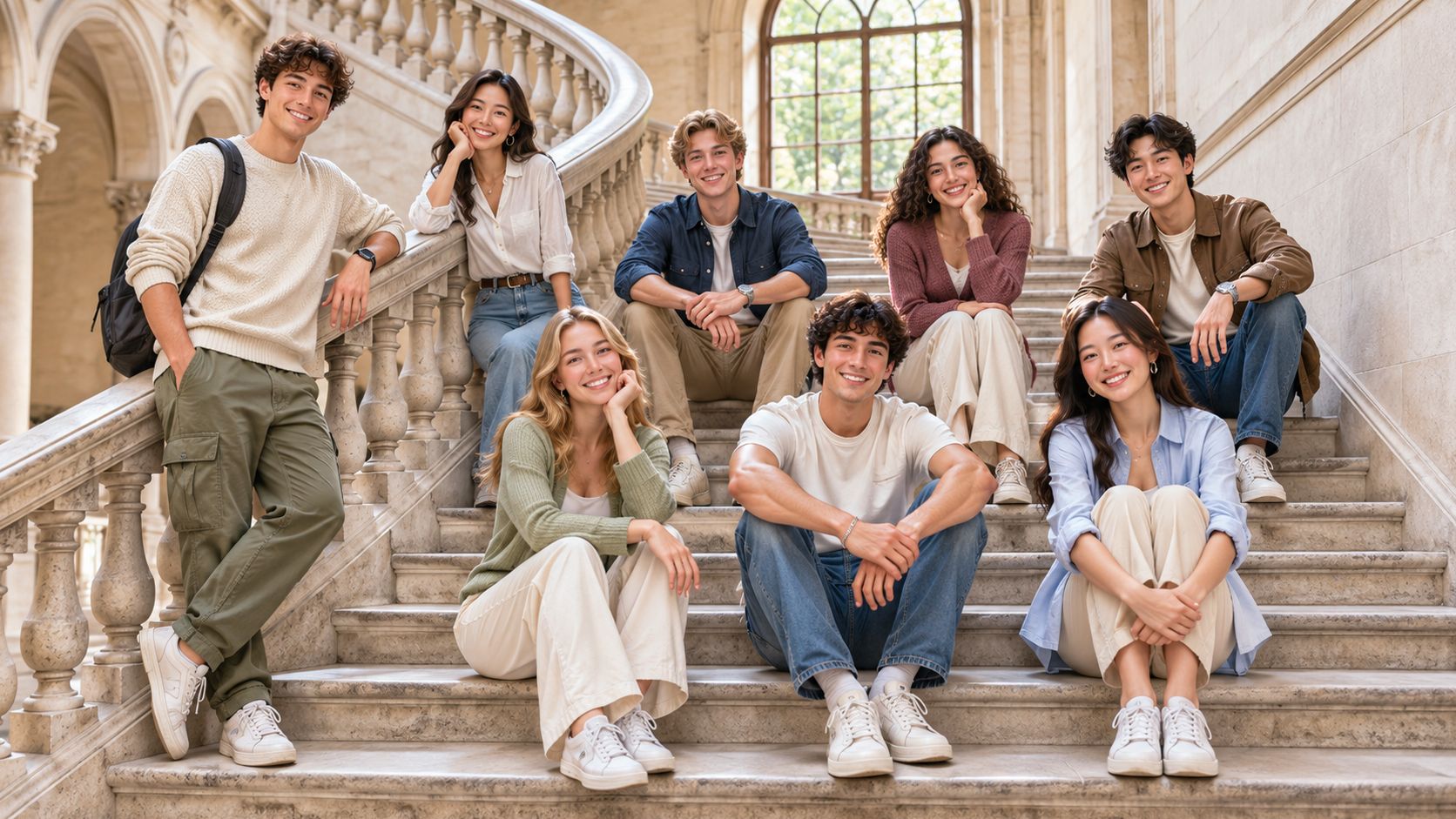
Place seated people front and center, standing people just behind and off to one side, and one person on a higher step so the eye travels. Explain roles in one sentence each. If you narrate a film plot, you will lose the room. The trade-off is personality versus speed. A tableau needs a planner. Without one it becomes awkward milling, and you should switch to the stair-step instead.
For a wedding party that wants a scene rather than a row, start with these wedding party photo ideas, and if you want seating charts with the same staged energy, browse creative tableau mariage concepts. With marks already set, the photo itself is still under five minutes.
How the eight creative group photo ideas compare
| Item | Best Group Size | Best Setting | Equipment Needed | Best For |
|---|---|---|---|---|
| Tiered Stair-Step Arrangement | 12 to 60 | Stairs, bleachers, or stable risers | Stable risers; camera | Formal or casual large-group portraits |
| Circular Huddle from Above | 6 to 16 | Stairwell, balcony, or other elevated viewpoint | Camera; safe elevated position | Striking, unified group photos |
| Synchronized Group Jump | 8 to 20 | Open space with a simple background | Camera with fast shutter and burst mode; wide lens | Energetic, celebratory photos |
| Golden Hour Silhouette | Up to about 12 | Outdoors at sunrise or sunset | Camera with exposure control | Dramatic, atmospheric portraits |
| Arm's-Length Selfie Crowd Shot | Up to about 8 | Informal gatherings | Smartphone with front-facing camera | Casual, shareable moments |
| Overhead Flat-Lay Group Arrangement | 4 to 10 | Plain ground or large surface | Camera; safe elevated position | Playful, graphic group portraits |
| Leading-Lines Corridor or Staircase Composition | 6 to 25 | Hallway, staircase, pier, or colonnade | Camera with a moderate focal-length lens | Structured portraits with depth |
| Cinematic Tableau with Varied Poses | 5 to 15 | Themed setting or location suited to the scene | Camera; optional props and costumes | Story-driven, personalized portraits |
Use this table as a logistics check before you gather anyone. Headcount changes the result more than style does. A stair-step needs enough people to create layers, while an arm's-length selfie falls apart once the group spreads beyond a tight semicircle. Space matters just as much. Overhead frames need a safe viewpoint and a clean surface, and leading lines need a corridor or staircase that draws the eye.
For speed, match the setup to the room you already have. A jump works in open space with fast shutter and burst mode. A silhouette needs low sun and exposure control. A tableau needs props and a clear plan, so it suits a smaller group that can hold positions. Pick the idea that fits the people and location in front of you, then assign one person to place the group before you start shooting.
Turn One Great Group Shot into a Full Event Record
Pick two or three of these setups, not all eight. Match them to headcount, the actual stairs or blanket you have, and whether people can move freely. Write a three-line shot list with the order and the name of the person who wrangles the group. Put the formal frame first, while energy and light are still on your side.
Leave two minutes of candid time between poses. Someone fixing a collar, a kid refusing to sit, the toast that starts early, those frames often outlast the jump. Don't make guests perform the same gesture twice for a vertical clip and a still. Shoot the still, then five seconds of the same formation moving, then stop.
A 2025 attendee-generated-content report lists photos as the most common attendee-created format at 96%, with videos at 58%. Your posed set will never be the whole day. Guests already have the table shots, the reactions, and the clip from the balcony. More files are not automatically better. Prompts should be easy to skip, and nobody should feel pushed to post publicly.
We built EventUploader for that handoff. You create one branded upload page with your colors, logo, and a short welcome, then print a single QR code. Guests scan it and send photos or videos straight from their phones, with no app and no account. You choose photos only, videos only, or both, and you can cap file size. The gallery is yours. You can download it in original quality, group favorites into as many albums as you want, and publish those albums on the same link, or keep them as a draft only you see. Name tags let guests search for themselves later. That is the practical close to any of these creative group photos ideas. The stair, the huddle, or the tableau is one composed minute. The upload page is how the rest of the room gets home with you.
EventUploader gives every wedding, birthday, offsite, or festival one branded page and a printable QR code so guests upload the frames you didn't pose, with no app to install. You keep the full set in original quality, then publish the albums you want on that same link. Set up your next event at EventUploader before the group hits the steps.