Family Reunion Photo Ideas: 8 Shots Worth Taking
Fresh family reunion photo ideas, from generational lineups to drone shots, plus a simple way to collect every guest's photos in one gallery.

Three weeks after the reunion, the folding tables go back in the shed and the photos are still scattered across twenty phones. Half of them sit in group chats nobody scrolls back through. The one frame everyone wanted, the whole family in one place, exists only on a cousin's device that flew home to another state.
That's not bad luck. It's a planning gap, and it closes before the weekend starts. Families who come home with a complete record choose their shots in advance, assign one person to each, and hand every guest a single place to send what they capture.
What follows are eight family reunion photo ideas, each treated as a small production plan. You get the setup time, the kind of gathering it suits, the trade-off that comes with it, and the collection method that keeps images out of someone else's camera roll. Some take five minutes. Two need a month of lead time. Choose three or four that match the size and energy of your reunion rather than running all eight, because a good photo plan is a schedule nobody has to chase.
The list starts with the shot almost every family wants and almost nobody schedules properly.
Table of Contents
- 1. Generational Portrait Lineup
- 2. Then-and-Now Recreation
- 3. Matching Theme Group Photo
- 4. Props and Photo Booth Station
- 5. Crowd-Sourced Guest Photo Collection
- 6. Family Photo Scavenger Hunt
- 7. Drone or Elevated Aerial Group Photo
- 8. Memory Table and Heirloom Photo Display
- 8 Family Reunion Photo Ideas at a Glance
- Bring Every Photo Home in One Place
1. Generational Portrait Lineup
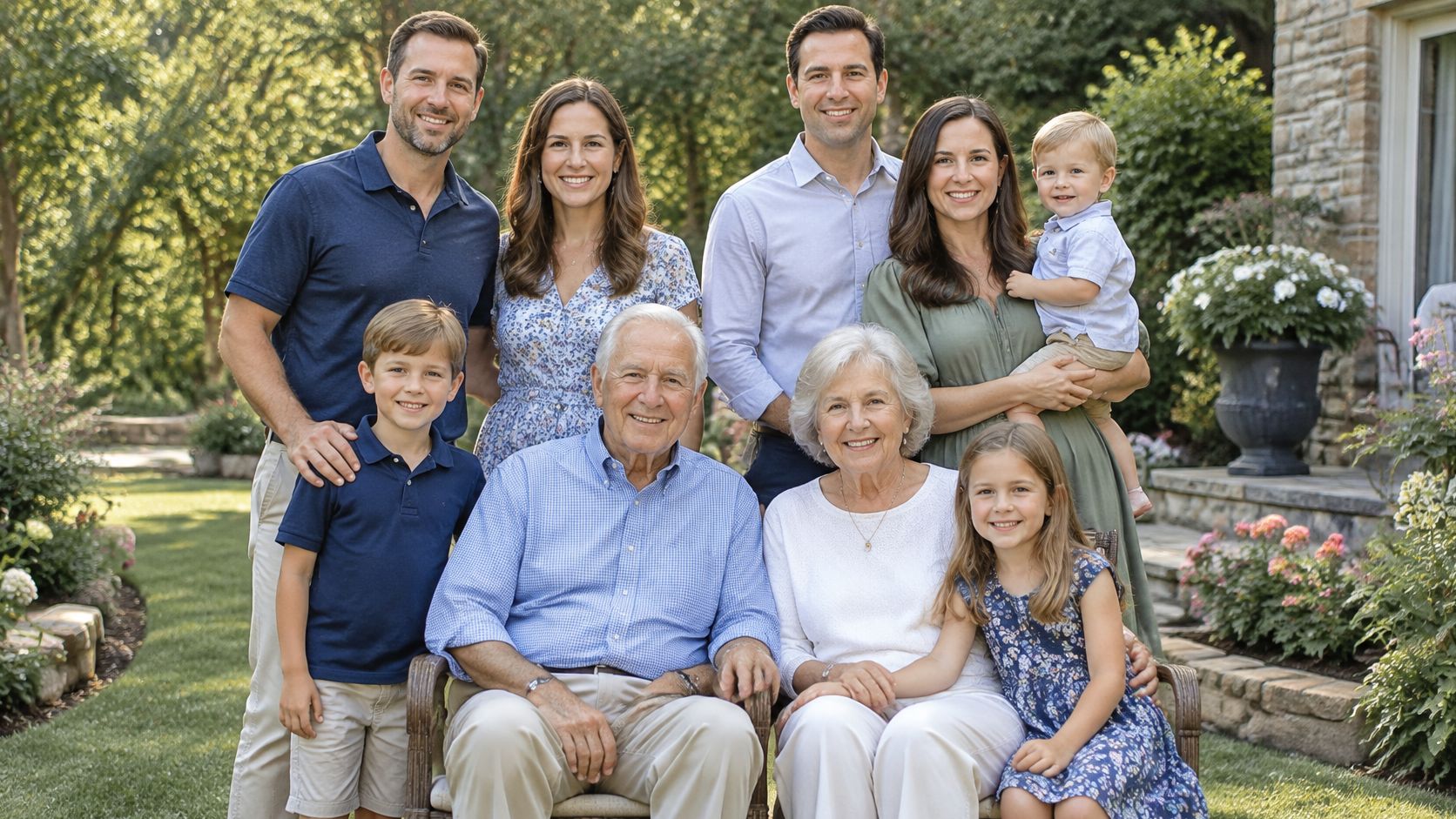
Every reunion has one photo that justifies the trip, and it's the one where the family lines up by generation. Grandparents seated in front, their children behind them, grandchildren on the back row, great-grandchildren wherever they will stand still. It compresses a century of one family into a single frame.
Schedule it rather than hoping it happens. The photography itself takes about fifteen minutes; budget thirty for pulling people out of the parking lot, the pool, and the kitchen. The most reliable slot is right after the main meal, before anyone changes out of good clothes. Put the time on the welcome sign, in the group chat, and on the upload page.
Attendance patterns argue for doing it identically every time. A YouGov survey of 33,834 U.S. adults conducted September 5 to 6, 2022 found that 50% had attended a family reunion within the previous decade, 38% within the previous five years, and 21% within the previous year. Repeat attendance is the norm, so keep one location, one arrangement, and one photographer. In five years, the comparison is the story.
Where the Shot Goes Wrong
The lineup fails at the edges, not the center. Someone gets left standing because there's no chair, or a relative with a walker is asked to manage a grassy slope for better light. Plan access before composition: a step-free route to the spot, a chair with a back, shade or an indoor backup, and a quiet corner for anyone who needs to reset. Multi-generational reunion planning guidance puts those requirements ahead of the picture itself, and that ordering is correct. Shoot a seated version and a standing version, and photograph relatives with limited mobility early, before the heat builds.
Practical rule: Say out loud that the portrait is optional. A smaller frame of willing faces beats a full frame of people who resent standing there.
Give one person the wrangler job: call names, check the back row for faces hidden behind heads, and fire five frames in quick succession so nobody's blink ruins the set. Then point guests to a QR code near the dessert table. Collecting family pictures into one shared gallery gets you the side angles and the candid frames taken while the official version was being arranged, which are frequently the better images.
2. Then-and-Now Recreation
The most emotionally loaded photo at a reunion usually isn't taken that weekend. It's the one from thirty years ago, re-shot with the same people in the same spot. Set the original beside the new version and you've built a timeline that needs no caption.
Lead time is the catch. This idea needs a month, not a morning. Ask relatives to submit scanned originals through the upload page weeks ahead, and be specific about what you want: group shots with four or more people, locations you can physically return to, and faces belonging to people who are still attending. Scan at 600 dpi on a flatbed when you can. A phone scan works if the print is flat and the light is even.
The One-Month Lead Time
Assign the recreation to a younger relative and give them the reference image on their phone. A Pew Research analysis of photo sharing habits found that 43% of U.S. cell owners ages 18 to 29 used Instagram in the cited survey, with more than a third of Instagram users reporting daily use, and that 47% of adult internet users had reposted photos or videos found online. The practical read is simple: the cousin who lives on her phone is the right person to hold the original, direct the poses, and shoot the new frame with a tripod or a steady stack of books.
Handle the hard cases with yourself before you handle them with the family. Some originals include people who have died, and recreating them can land as tribute or as ambush depending on the family. Offer the softer version instead: same location, same framing, whoever is present, with the absent relatives represented by an empty chair or a held photograph.
- Keep poses simple: avoid anything requiring kneeling, climbing, or balance, so older relatives can join without risk.
- Match the crop: print both versions at the same size, side by side, for a comparison people can hold.
- Shoot the wide and the tight: one frame matching the original exactly, one pulled back to show today's full group.
3. Matching Theme Group Photo
Coordination is the whole project here. A unified color palette turns a scattered crowd into a graphic that reads at thumbnail size, and it hides the camp chairs, coolers, and sunscreen. Announce it four to six weeks out. A theme unveiled at the gate produces a lineup of people apologizing for their shirts.
Announce two routes, not one. Either a shirt in the group color, or a neutral outfit with one accent in that color. Families coordinating outfits for other events have already solved the hard parts of palette choice and sizing runs, and a group matching outfit guide covers those decisions in a way that transfers directly to a reunion. Give people a color name and a photo reference, not a vague instruction like "wear blue."
The format is well established for a reason. Zenfolio's 2024 State of the Photography Industry report ranked family photography as the third most common specialty among its respondents, which tells you coordinated group portraits are a familiar product. Families generally know how to dress for a palette when someone names it clearly in advance.
Making Coordination Easy
Set the photo in the coolest hour available and pick a background that lets the color do the work. A neutral wall, a white tent side, or an open field beats a busy garden. Shoot one wide frame of the whole group, then break it into household clusters in the same palette, because those smaller frames are the ones relatives print.
A theme that costs a family of five $80 in new clothes isn't a theme, it's a tax. Treat the accent-color option as equal billing and nobody has to buy anything.
Assign a photo helper to spot wardrobe problems before the shutter: a bag strap across a face, a shirt riding up, sunglasses left on heads. Two minutes of checking saves an entire reshoot.
4. Props and Photo Booth Station
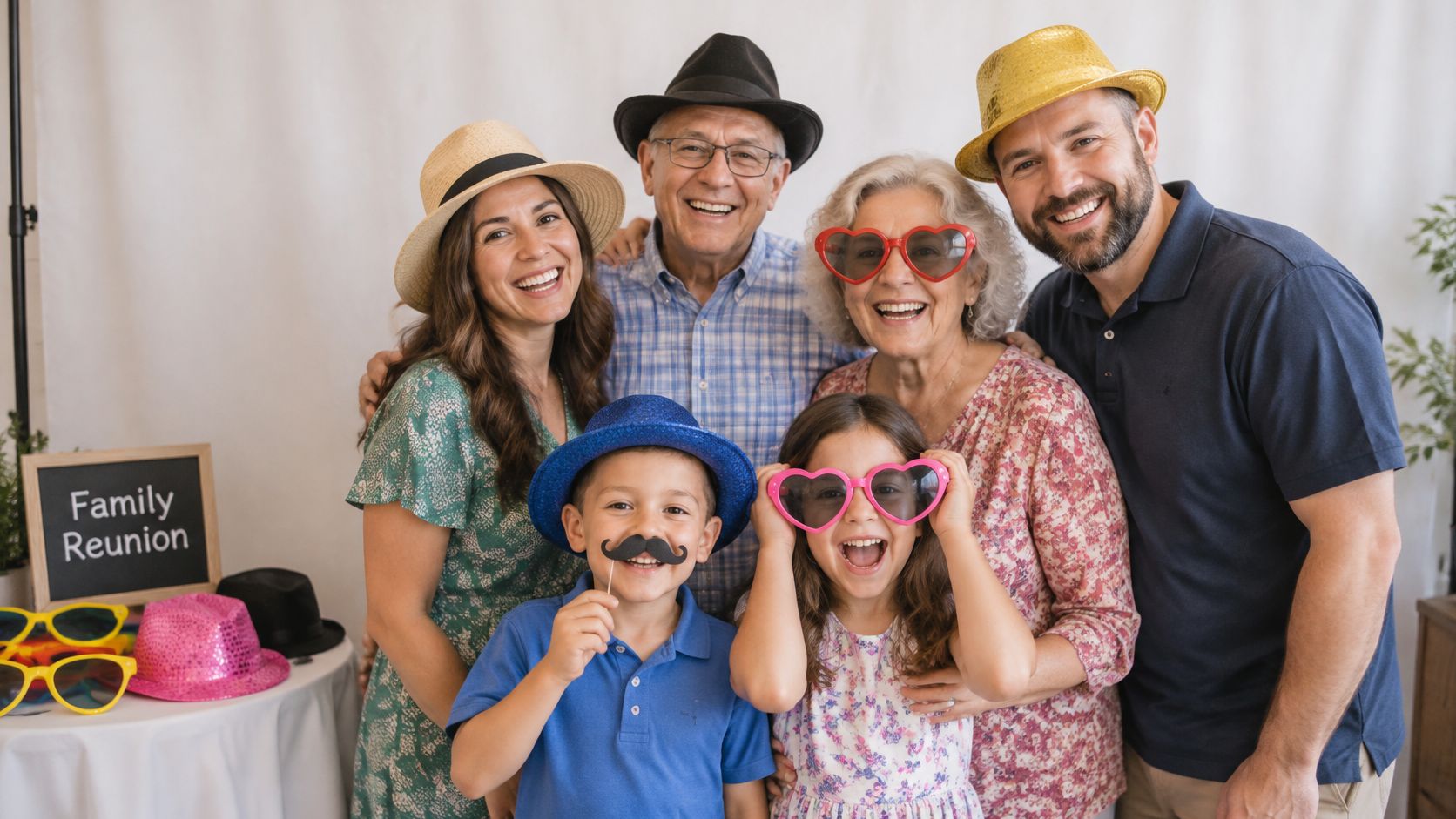
A photo booth station is the lowest-friction way to photograph guests who would never walk toward a formal lineup. Backdrop, a handful of props, one portable light, a sign explaining what to do, and a helper who refreshes the setup every hour. Total build time runs about forty-five minutes, including taping down the backdrop stand.
Placement decides whether it works. Put the station near natural light but out of direct sun, close enough to the drinks that people pass it, far enough that it doesn't block the food line. Seed it early with the teenagers while you're still setting up. They'll occupy it all evening, and younger kids copy whatever the teenagers do. A party supplier's photo booth planning guide covers backdrop anchoring and prop rotation in more detail than most hosts expect to need.
Position, Light, and Traffic
The habit is already there; friction is what kills a booth. Pew Research's photo and video sharing report found that 54% of adult internet users had posted original photos or videos online, while 62% had created or curated visual content, in a study where 92% of U.S. adults owned a cell phone and 58% owned a smartphone at the time of measurement. People share. What they won't do is download an app or create an account at a family party, so keep the upload path in the browser and put the QR code on the station itself.
- Light it once: one continuous LED panel at 45 degrees beats overhead fluorescents and on-camera flash.
- Print the instructions large: "Scan, choose your photos, upload" in 72-point type, at eye level.
- Refresh the props: swap hats and signs halfway through so the second wave of photos looks different from the first.
5. Crowd-Sourced Guest Photo Collection
This is the idea that makes the other seven survivable. Every guest uploads their own photos and videos to one gallery, and the reunion ends up documented from sixty angles instead of one. It captures what no single photographer can: the conversation on the porch, the kids under the sprinkler, the kitchen at 11 p.m.
Setup takes about ten minutes before the event and costs you nothing on the day. Create the page, write a two-sentence welcome message explaining what it's for, and generate the QR code. Print it on table cards, tape a copy to the drinks cooler, and put the largest version on a welcome sign at the entrance. If you're still working out the weekend's shape, this walkthrough on how to plan a family reunion covers where the collection step fits into the rest of the schedule.
The Ten-Minute Setup
The behavior you're relying on is well documented in family settings. A 2017 survey of more than 1,000 U.S. smartphone users found that 85% preferred smartphones for holiday photography, and 51% named a family picture as the photo they most wanted from the holidays, according to coverage of the survey in the Chicago Tribune. Reunion weekends aren't holidays, but the pattern holds: phones are the camera, and the group portrait is the image people care about most.
Say a family of sixty gathers for a Saturday. Maybe thirty of them will take photos and eight will remember to send them anywhere. The QR code changes the second number, not the first.
Setup note: Send the upload link again the next morning. People mean to contribute and forget, and a 24-hour reminder catches the photos still sitting in camera rolls.
Watch submissions live from the dashboard during the day. When you have enough, close uploads, review the set, and publish a curated gallery on the same link guests already used.
6. Family Photo Scavenger Hunt
Give guests a list instead of a request and participation jumps. Teams of relatives work through photo prompts around the reunion site for 60 to 90 minutes, then upload everything to one place. It's the only item on this list that photographs the event and entertains people at the same time.
Keep the prompt list between 10 and 15 items, and build in mobility. A prompt that reads "climb the hill for a group jump" excludes half the family. Better prompts are social rather than physical.
- Three generations in one frame: the single most requested result from any hunt.
- Someone laughing so hard they can't finish a sentence: catches people mid-party rather than posed.
- A photo at the oldest picnic table or the original farm gate: anchors the hunt to the place.
- A recipe in progress: hands, bowls, and flour, with no faces required.
- A grandparent's story told in a 20-second video: a short oral history clip no one else will record.
Put one designated uploader on each team so images arrive in one batch rather than five. Ready-made scavenger hunt prompts delivered by QR code save the design work, and printed cards work fine for teams whose phones are low on battery.
Volume isn't the problem. A 2023 OnePoll survey of 2,000 U.S. adults, commissioned by Mixbook, found that respondents took an average of nearly 23 photos per special event, reported by StudyFinds. The hunt's value is that it points that volume at the people and moments you'd otherwise miss. Award a cheap prize for the most complete list and a second for the funniest single image, then publish the best shots to the shared gallery.
7. Drone or Elevated Aerial Group Photo
The aerial shot answers a question no other format can: how big did this get? Eighty relatives in a field, arranged into a shape, photographed from twelve feet up, and you have an image people frame. It's also the item most likely to fail, so decide early whether it's worth the effort.
Setup depends entirely on your altitude source. A drone needs a licensed operator, venue permission, and airspace checks, plus wind that cooperates. A ladder, a second-floor balcony, a stage, or a hillside costs nothing and needs no paperwork. For most reunions under a hundred people, a raised platform is the smarter trade: less risk, faster, and nobody has to explain a flight plan to a park ranger.
Formations That Read From Above
Lay the formation out on the ground before anyone is called. Mark positions with cones, chalk, or picnic blankets, then walk the shape yourself and check it from the camera's height. A heart, a circle of chairs with the oldest generation at the center, or the family name spelled out in bodies all read clearly. A loose crowd does not.
Get everyone in position, then take the shot in the first ninety seconds. Aerials fall apart when people start talking to the person beside them and drift out of line.
Work the timeline in reverse. Announce the aerial photo for a specific hour, gather people five minutes early, and assign two spotters to move individuals into place while someone else works the shutter. Shoot the straight-down frame and a three-quarter angle, because the angled version usually flatters the location and the flat version is the one that reads as a pattern.
8. Memory Table and Heirloom Photo Display
A table of old photographs, documents, and keepsakes gives the reunion something to gather around between meals. Add a QR code linking to the shared gallery and the table becomes a two-way archive: relatives browse the past, scan the code from their phones, and add today's pictures to the same collection.
This is the highest-prep idea on the list. Plan on one to three weeks of collecting, scanning, and labeling before anyone sees a print, so it suits reunions where family history is the point of the day. If the crowd skews young and nobody owns the old albums, I would put that prep time into a livelier idea instead.
Handling the Originals
Scan before anyone handles anything. Work through the collection ahead of the event at 600 dpi, and return each original to its owner the same day it comes out of the sleeve. Display copies, never irreplaceable prints, and use acid-free sleeves or photo-safe backing for anything on show. Label each item with names, an approximate year, and who lent it, because that information disappears the moment the lender goes home. Upload the scans to the event gallery as you finish them, so the archive exists even if a displayed copy gets damaged.
- Assign a story collector: one volunteer with a phone, recording 30-second clips of whoever explains a photo.
- Keep a lending log: a simple numbered list of who brought what, so nothing leaves with the wrong branch of the family.
- Set the display height: waist level or above, well back from food, drinks, and small hands.
Set the distribution rules before anyone takes a picture. A private family gallery, an invitation-only album, and a public post reach three different audiences, and plenty of people share family photos with no privacy limits on their accounts at all. Say which one you're running, ask parents before anything with their children leaves the family circle, and give anyone the option to be left out. Guidance on family reunion photography covers consent and sharing choices in more depth.

8 Family Reunion Photo Ideas at a Glance
| Idea | Best For | Setup Time | Difficulty |
|---|---|---|---|
| Generational Portrait Lineup | Large reunions with several generations | 15 to 30 minutes | Moderate; coordinating a large group takes time |
| Then-and-Now Recreation | Reunions that celebrate family history | 2 to 4 weeks to collect and scan old photos | Challenging; requires preparation and photo matching |
| Matching Theme Group Photo | Large reunions with a shared identity | 3 to 6 weeks for planning and ordering | Moderate; requires advance coordination |
| Props and Photo Booth Station | Reunions with mixed ages and a social atmosphere | 30 to 60 minutes | Easy; needs a simple setup and occasional monitoring |
| Crowd-Sourced Guest Photo Collection | Reunions needing a complete collection of memories | 10 to 20 minutes | Easy; requires an upload link and reminders |
| Family Photo Scavenger Hunt | Outdoor or multi-room reunions with active families | 1 to 2 hours to plan prompts | Moderate; requires clear rules and planning |
| Drone or Elevated Aerial Group Photo | Large outdoor reunions with open space and good weather | 1 to 2 hours, including permits and planning | Challenging; may require a skilled operator and permits |
| Memory Table and Heirloom Photo Display | Multi-generational reunions focused on family history and storytelling | 1 to 3 weeks to collect, scan, and label materials | Challenging; requires careful collection and organization |
Bring Every Photo Home in One Place
Eight ideas, one failure mode. Every one of them collapses if the images stay on the phones that took them. The lineup lives on the tripod owner's camera. The then-and-now lives on the documentarian's phone. The scavenger hunt lives in five separate group chats, and the cousins who couldn't attend never see any of it.
Collection deserves as much planning as the shots. Decide the destination first, then build the prompts around it. A single branded upload page with a printable QR code handles the whole job: guests scan, choose their files, and upload straight from the browser. No app, no account, no forty-message thread hunting for who has the good version of Grandma with the great-grandchildren.
The mechanics that matter on the day are unglamorous. Put the QR code where people queue, at the welcome table, the bar, the photo booth, and the dessert table. Say the link out loud once after the group portrait, when everyone is standing in one place and paying attention. Send it again the next morning, because a third of the photos get uploaded in the 24 hours after everyone goes home.
Then curate. A complete set of 900 phone photos is an archive nobody scrolls. A curated album of 60, published on the same link guests already used, is what the family shares. Keep the originals too, downloadable in full quality, so the album can be reprinted, projected at the next reunion, or handed to whoever is planning the memorial slideshow in ten years.
One structural point worth repeating: assign owners. The lineup needs a wrangler, the recreation needs a documentarian, the station needs a refresher, and the gallery needs someone who checks it on Sunday morning. Photography at a reunion fails through diffusion of responsibility, not through bad cameras.
Finally, set the privacy terms before the first photo. Tell guests who can see the gallery, whether it will be posted publicly, and how to opt out. That one paragraph of housekeeping prevents the awkward conversation in November when someone finds their kid on a public feed.
The photos are the part of the reunion that outlasts the reunion. Treat them like the other logistics you'd never leave to chance, and the weekend keeps giving long after the last cooler is packed.
EventUploader gives your reunion one branded page and a printable QR code, so guests upload from their phones in the browser with no app and no account, and every photo and video lands in a gallery you own and can download in original quality. Set it up before the weekend, gather everything in one place, then publish a curated album on the same link so relatives who couldn't make it can still see the day. Start your reunion gallery at EventUploader and stop chasing photos across group chats.