Planning a 50th Birthday Party: Step-by-Step 2026 Guide
Planning a 50th birthday party? Follow this 2026 step-by-step guide with a planning timeline, budget breakdown, food quantities and photo tips.
In the early 20th century, average life expectancy in many societies sat close to 50, so a fiftieth birthday marked something near the edge of a normal life. Longevity changed, and birthday statistics compiled by Birthday Speeches now describe 50 as a midpoint or a new life stage rather than an endpoint. The party changed with the number. A 50th is the one night when a person's entire timeline stands in the same room: siblings, adult children, friends from three decades back, colleagues who have never met the family.
That mixed room is why planning a 50th birthday party works better as a small production than as a mood board. You need a date, a scope, a ceiling with a reserve behind it, a confirmed headcount and a run sheet. Themes are the cheap part, and they come last.
Table of Contents
- Your 50th Birthday Plan at a Glance
- Work Backward From the Party Date
- Set a Budget With a Contingency Reserve
- Choose a Theme and Venue That Fit the Guest of Honor
- Coordinate Guests and Keep Everyone Comfortable
- Plan Food and Drink Quantities With Real Numbers
- Capture the Memories and Share Them After the Party
Your 50th Birthday Plan at a Glance
Round-number birthdays do something to guest lists. The 30th, 40th and 50th are the ages most likely to get full milestone treatment, with larger invite lists and more elaborate celebrations than an ordinary year, and that's precisely why the 50th rewards a deliberately designed experience instead of an informal gathering. The guest of honor's preferred tone comes first: an intimate dinner, a surprise reception, or a bigger party with speeches, displays and shared memories. Everything after that is logistics.
The format also has to hold several generations at once. Siblings in their fifties, adult children in their twenties, parents in their eighties, and work friends who know nobody else in the room. That mix rules some things out immediately: a venue with stairs at the entrance, a two-hour standing cocktail format, and a playlist loud enough to end conversation.
Seven steps cover the whole build:
- Fix the date, the format and a budget ceiling. Intimate dinner, surprise reception or full milestone party. Choose the ceiling before you browse a single venue.
- Draft the guest list against the room, not the invitations. Size the space for the number of people likely to arrive, not the number you'd love to invite.
- Book the venue and major suppliers 8 to 10 weeks out. Caterer, entertainment and any rentals that would be painful to lose.
- Build the theme from the guest of honor's story. Their music, their travels, their family recipes, their next chapter.
- Send invitations with a firm RSVP deadline. Two dates on the card: the party and the day you stop chasing.
- Calculate food and drink from the confirmed headcount. Never from the invitation list.
- Set up photo collection and a day-of run sheet. One shared upload page and one printed timeline solve most of the chaos.
What actually fails: buying signage, balloons and favors before the venue and guest experience are settled. You then spend the rest of the project forcing the party into the wrong shape.
Each section below expands one of those steps. If you want the version you can pin to a fridge, track party prep with Pretty Progress and use its printable checklist alongside the dated gates here.
Work Backward From the Party Date
The date is the only fixed point in the project, so every decision hangs off it. Fix the experience objective first (an intimate family dinner, a surprise reception, a memory-focused celebration), then set a maximum guest count and a budget ceiling before anyone opens a venue website or a menu. Party Genius AI's 50th birthday planning guide reports that 33% of hosts exceed their initial budget and works to a 70-80% attendance assumption for invitees. Both numbers shape the plan: the reserve isn't optional, and the room you book shouldn't be sized for the invitations you send.
The gates where money gets committed
- Gate one, 10 to 12 weeks out. Objective, guest target, budget ceiling and a venue shortlist approved. Nothing gets booked until all four exist on paper.
- Gate two, 8 weeks out. Venue, caterer and entertainment contracted, deposits paid, accessibility requirements confirmed in writing, and a named coordinator if this is a surprise.
- Gate three, 6 weeks out. Invitations out with a clear RSVP deadline, cake, decor and rentals ordered while there's still choice.
| When | Tasks due | Output or deadline |
|---|---|---|
| 10-12 weeks out | Set date and format, fix budget ceiling, draft guest list, shortlist venues | Objective, guest target and budget approved |
| 8 weeks out | Book venue, caterer and entertainment; confirm accessibility needs | Contracts signed, deposits paid |
| 6 weeks out | Send invitations with RSVP deadline; order cake, decor and rentals | Invitations out, RSVP deadline set |
| 4 weeks out | Finalize menu, drinks plan and photo collection setup | Menu confirmed, upload page and QR code live |
| 2 weeks out | Chase remaining RSVPs, plan seating, reconfirm suppliers | Provisional headcount and seating plan |
| 7-10 days out | Lock final headcount; pay caterer against confirmed count | Final numbers sent to all suppliers |
| 1 week out | Final review of run sheet, arrivals, parking, quiet area, contingency check | Day-of run sheet distributed |
| Day before | Collect rentals, set up decor, print signage and QR cards, charge devices | Venue ready, coordinator briefed |
| Party day | Coordinator arrives early, manages schedule, greets guests | Party runs to plan |
Apply the attendance math before you sign. If the room comfortably seats 30, inviting roughly 38 to 43 suitable guests gives you a working buffer, while the caterer still gets paid against the final confirmed count locked 7 to 10 days out. Booking early against a list you haven't tested is how hosts end up with a hall that feels half empty.
The same backward structure works for other milestone events. This guide to planning a retirement party runs identical gates with a different guest list, which is worth borrowing if you're organizing two celebrations in one year.
The final stretch is confirmation, not creativity. Two weeks out you chase missing RSVPs by phone and sketch the seating. One week out you hold a single operational review covering the run sheet, arrivals, parking, the quiet area and what happens if a supplier is late. Surprise-party logistics (arrival timing, concealment, where guests park) belong with the guest workstream, not on a mental list.
The rule that keeps the table honest: a task with no owner and no date will not happen. Assign a name to every row, including your own.
Set a Budget With a Contingency Reserve
A 2025 survey of 1,000 people who had planned an adult birthday, cited in Peerspace's guide to adult birthday party budgeting, found average spending of $1,185 against a median of just $500. That gap is the useful part. Half of hosts spend $500 or less, and the average is dragged upward by a minority of expensive celebrations. A memorable 50th doesn't require joining that minority. It requires knowing which lines to protect.
Food, drinks and catering come out as the dominant expense in that same survey, which is why food deserves the biggest share and the tightest control. It's priced per confirmed head, so it's the line that swings most when your RSVP count moves.
A sample budget you can copy
| Budget line | Share of budget | Notes |
|---|---|---|
| Venue | 25% | Private room, hall or garden rental ($375) |
| Food and catering | 30% | Largest single line; priced per confirmed head ($450) |
| Beverages | 10% | Include substantial non-alcoholic options ($150) |
| Entertainment | 5% | Playlist and speaker up to live music ($75) |
| Decor and cake | 8% | Theme pieces, flowers, birthday cake ($120) |
| Rentals, service fees and taxes | 7% | Often forgotten; ask suppliers for all-in pricing ($105) |
| Photo and media | 5% | Guest upload page, prints, short pro session ($75) |
| Contingency reserve | 10% | Covers overages; not an upgrade fund ($150) |
| Total | 100% | $1,500, with the reserve held back |
The reserve is the line that saves the party. It covers the service charge you didn't see, the extra head that appeared, the dietary substitution, the taxi home for a guest who shouldn't drive. Spend it on nothing else, and don't let it become a quiet upgrade fund for better florals.
Three trade-off rules worth applying
- A slightly smaller guest list beats a fancier venue. Thirty people who matter in a warm room outperform fifty in a space that's too tight or too formal.
- Self-service stations beat plated service on cost per head. You trade some polish for real money, and it suits a mixed-age crowd that's moving around anyway.
- Guest-collected photos can carry the candid coverage. Candid uploads from the room often capture what a hired photographer misses, and they free money for food, access or a short professional portrait session if you want formal shots.
Separate your must-haves (safe access, enough food, comfortable seating, sound that works) from optional upgrades (elaborate floral work, a live band, a premium bar). Hidden costs break most budgets: service charges, dietary substitutions, transport, overtime hours, deposits, accessibility accommodations and the contingency itself. Price every one of them before you commit to the venue.
Budget test: if you can't name what you'd cut first, your budget isn't finished. Decide the order of sacrifice in advance, while you're calm.
Choose a Theme and Venue That Fit the Guest of Honor
Themes cost very little and venue choices cost everything, so settle the room before the mood board. Three questions get you to a usable direction: what does this person love, which decade shaped them, and do they want intimacy or spectacle? A shy celebrant and a grand entrance are a bad pairing regardless of how good the decorations look.
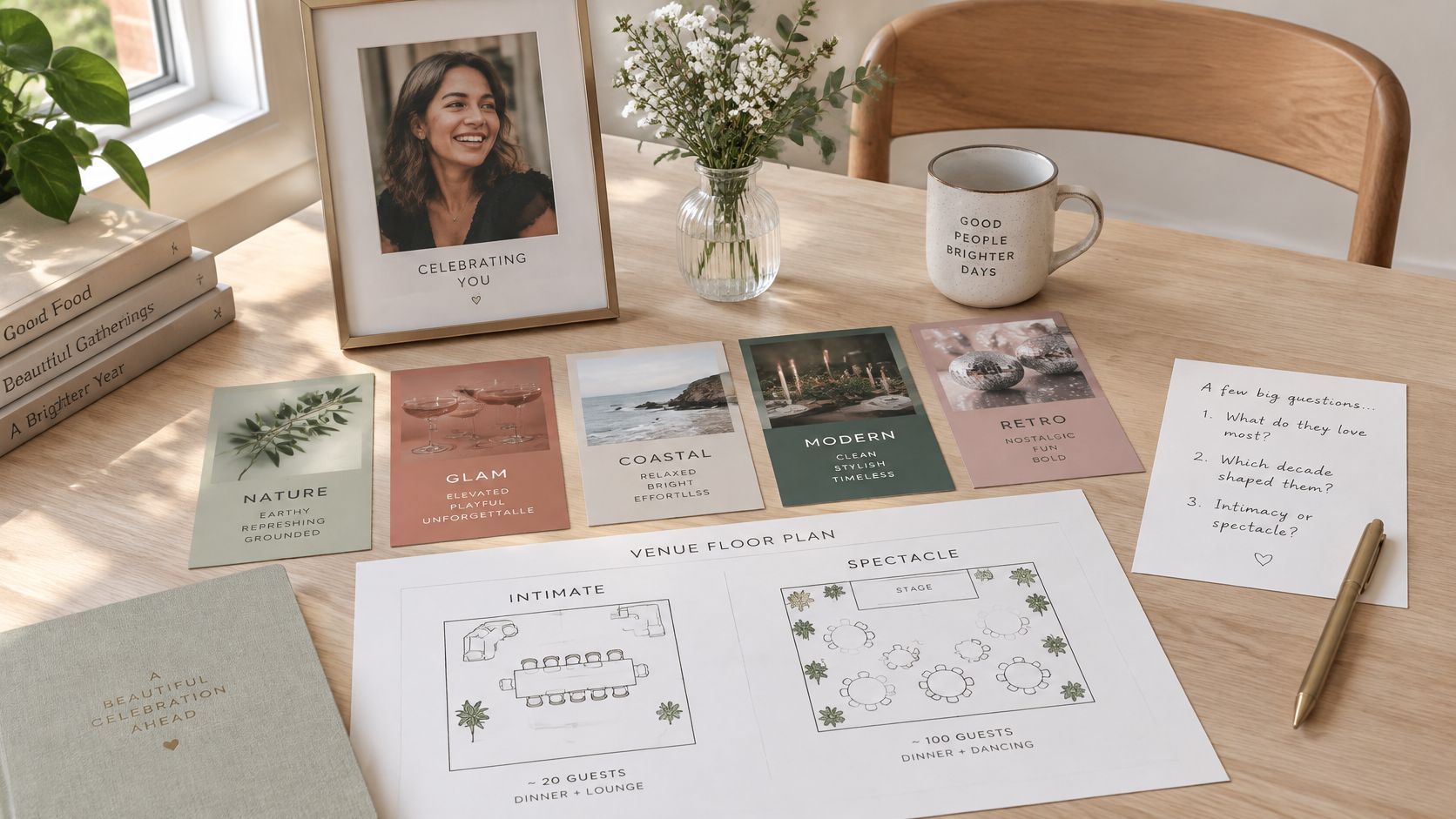
Five directions that work, each with a different execution cost:
Fifty and Fabulous in gold and black, with a champagne tower and metallic signage. It's the classic 50th look, easy to source and it photographs well, though it can feel generic if it's the only idea in the room.
This Is Your Life builds a memory wall with a photo timeline from baby pictures to last summer, plus short written captions from family. Cheap to produce and usually the most-talked-about corner of the night.
A decades party runs on the music of the guest of honor's teens and twenties, with a playlist built by someone who was there. Pair it with a few printed album covers rather than costume pressure.
Next Chapter centers on what's ahead: travel plans, a hobby they've been circling, a retirement map. Guests contribute a suggestion or a memory on a card, and the result is a plan rather than a nostalgia exercise.
A hobby theme (wine tasting, golf, gardening, cooking) gives you activities, a menu direction and conversation in one move, which matters when the guest list spans four decades of friendship.
Then compare venues on the same four criteria.
| Venue | Cost | Effort | Accessibility |
|---|---|---|---|
| Home | Lowest | High: setup and cleanup fall on the host | Check step-free access and toilets |
| Restaurant private room | Fixed per head | Low: catering handled | Check step-free entry; limited decor freedom |
| Community hall or event space | Mid | Medium: rentals and setup required | Blank canvas; check parking and toilets |
| Garden or outdoor | Mid to high, site-dependent | High: weather backup needed | Check ground surface, shelter and paths |
A restaurant private room is the low-effort choice and the one most hosts underestimate for cost predictability. A hall gives you control and asks for rentals. Outdoors is memorable and demands a wet-weather plan in writing. If a gift is part of the occasion and the celebrant is a whiskey drinker, personalized whiskey gifts for turning 50 solve the "what do we give someone who has everything" question with something they'll look forward to opening.
Five checks before you sign anything: does the capacity match your confirmed target, is the entrance step-free, what's the all-in cost including fees, what are the catering rules, and are there noise or curfew limits? Browse more 50th birthday party theme ideas once your venue is locked, not before.
Coordinate Guests and Keep Everyone Comfortable
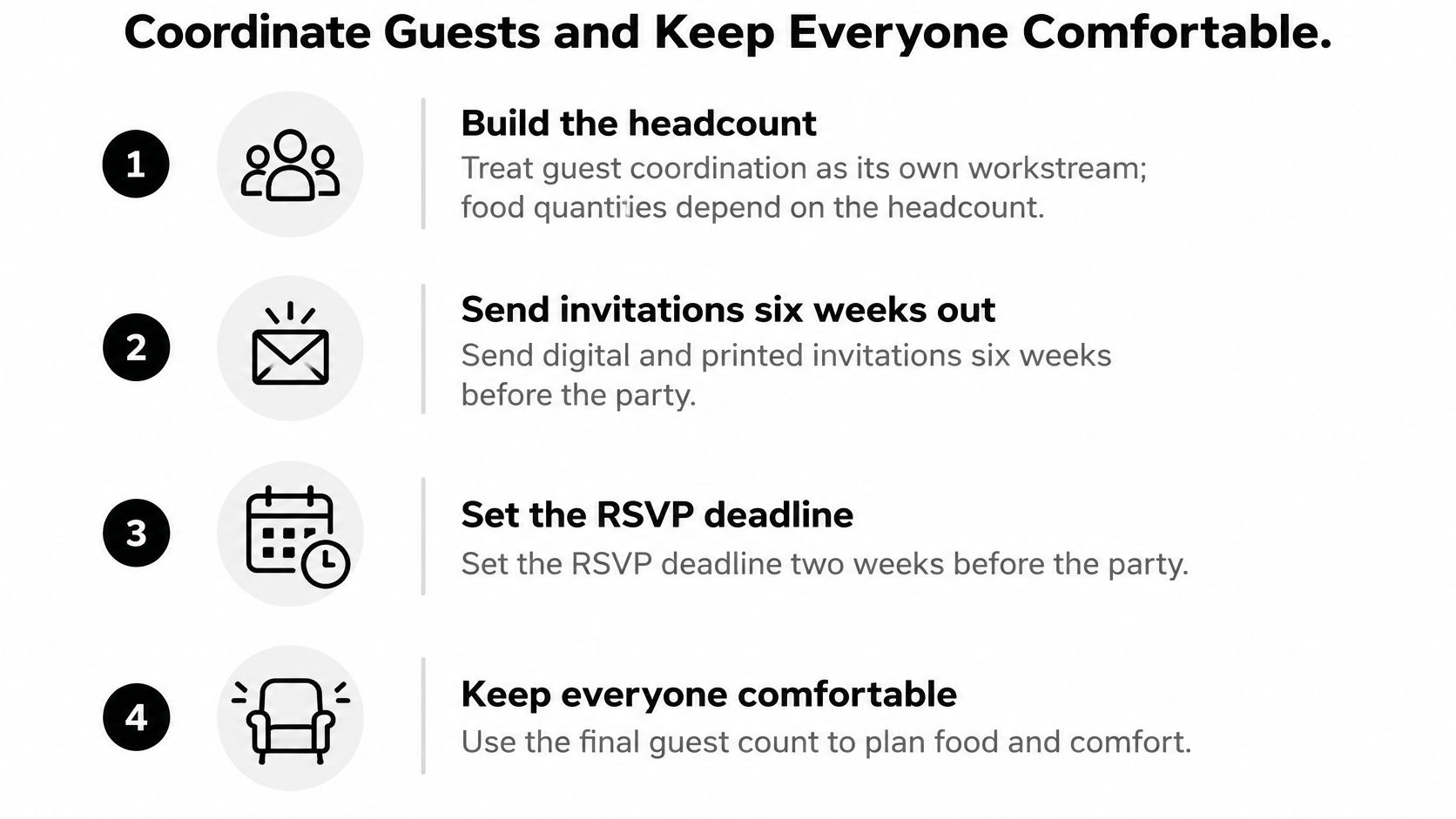
Guest coordination is its own workstream, and it's where the food numbers come from. Send invitations six weeks out, in both digital and printed form, with an RSVP deadline two to three weeks before the party. Build one segmented list from the replies: adults, children, drinkers, non-drinkers, dietary requirements, mobility needs, and anyone who needs a lift. Chase stragglers by phone rather than text, then lock the final headcount 7 to 10 days out.
Accessibility that doesn't feel like a hospital form
Most 50th birthday checklists cover themes, menus and entertainment, and skip the practical guidance that a mixed-age room needs. Neutral event guidance such as the Murray River Council event guide recommends checking step-free entrances, accessible parking and toilets, continuous pathways, lighting, transport access, emergency procedures and accessible online registration. Translate that into party terms:
- Seats spread through the room, not a wheelchair space parked by the fire exit.
- A quiet area away from the speakers, for an older guest or a toddler who needs a break.
- Large-print menus and printed programs at every table.
- Captions on the slideshow and any video, and a lower-volume zone near the bar.
- Real non-alcoholic choices, not just water and a dusty orange juice.
- A schedule with gaps, so nobody has to stand through an hour of speeches.
The design goal is a party that works for everyone, without a visible medical checklist attached to it. That's a format question, not a signage question.
Surprise parties need one named coordinator
If the guest of honor doesn't know, name a coordinator who isn't the host. They own the arrival time, the concealment plan, parking instructions and a simple signal when the room goes quiet. The host should be free to greet people.
If you'd rather see the sequencing in motion than read it, this walkthrough covers the same guest workstream from invitations to day-of roles.
A few failures are predictable, so plan the fix now. Late RSVPs get a phone call, not another reminder email. No-shows are absorbed by the attendance buffer you built into the room. One spare vegan and gluten-free plate covers the guest who forgot to mention it. An outdoor plan needs an indoor fallback agreed with the venue in writing. Guests who don't use apps get a printed RSVP card, a phone number and an assigned helper on the night.
You leave this workstream with two documents: a guest log with segments and dietary notes, and a one-page run sheet that says who does what, and when.
Plan Food and Drink Quantities With Real Numbers
Anchor every quantity to the service format before you buy anything, because the same 50 guests eat very differently at a plated dinner and a standing reception. Then use the confirmed headcount from the guest log. The per-guest benchmarks in Raquel's Reviews guide to party food quantities give you numbers a caterer will recognize.
| Item | Amount per guest | Notes |
|---|---|---|
| Plated dinner protein | 6-8 oz cooked | One main protein, plated service |
| Buffet protein, two choices | 8-10 oz total | Split across the two proteins |
| Hors d'oeuvres, 60-minute reception | 6-8 pieces | Served before a meal, not instead of it |
| Hors d'oeuvres replacing dinner | 12-16 pieces | Heavier, substantial pieces |
| Drinks, first hour | 2 servings | Per guest in hour one |
| Drinks, each extra hour | 1 serving per hour | Add a 10% contingency to the total |
| Total drinks, 4-hour party | 5 per guest | 250 servings for 50 guests, about 275 with the contingency |
Work one example end to end. Fifty adults, four-hour evening, plated dinner. Protein at 6-8 oz per person lands at 300-400 oz cooked, so about 19 to 25 pounds, plus two sides and dessert. Drinks follow the service model: two servings per guest in the first hour, then one per guest for each of the three remaining hours, which is five servings each and 250 total, rising to roughly 275 with the contingency. Then split those 275 servings deliberately between water, soft drinks and alcohol based on how many of your fifty drink. If wine is on the list, settle pours before you order, and this guide to how many glasses of wine are in a bottle does the bottle-to-glass arithmetic for you.
Three mistakes account for most shortages. Estimating from invitations sent rather than replies received. Buying the same quantities for a cocktail hour that you'd buy for a sit-down meal. And treating non-alcoholic options as an afterthought, which leaves a third of a mixed-age room nursing warm water while everyone else has a glass in hand.
Numbers to hand your caterer: confirmed headcount, service format, protein target in ounces, hors d'oeuvre count, drink servings by hour, and the dietary segments from your guest log. That's a brief, not a guess.
Capture the Memories and Share Them After the Party
A 50th gathers people who are rarely in the same room, and the candid shots are the souvenir that lasts. The professional portrait gets framed. The photo of two old friends laughing at the bar is the one the family sends around for years. Chasing those images across group chats two weeks later is how they get lost.
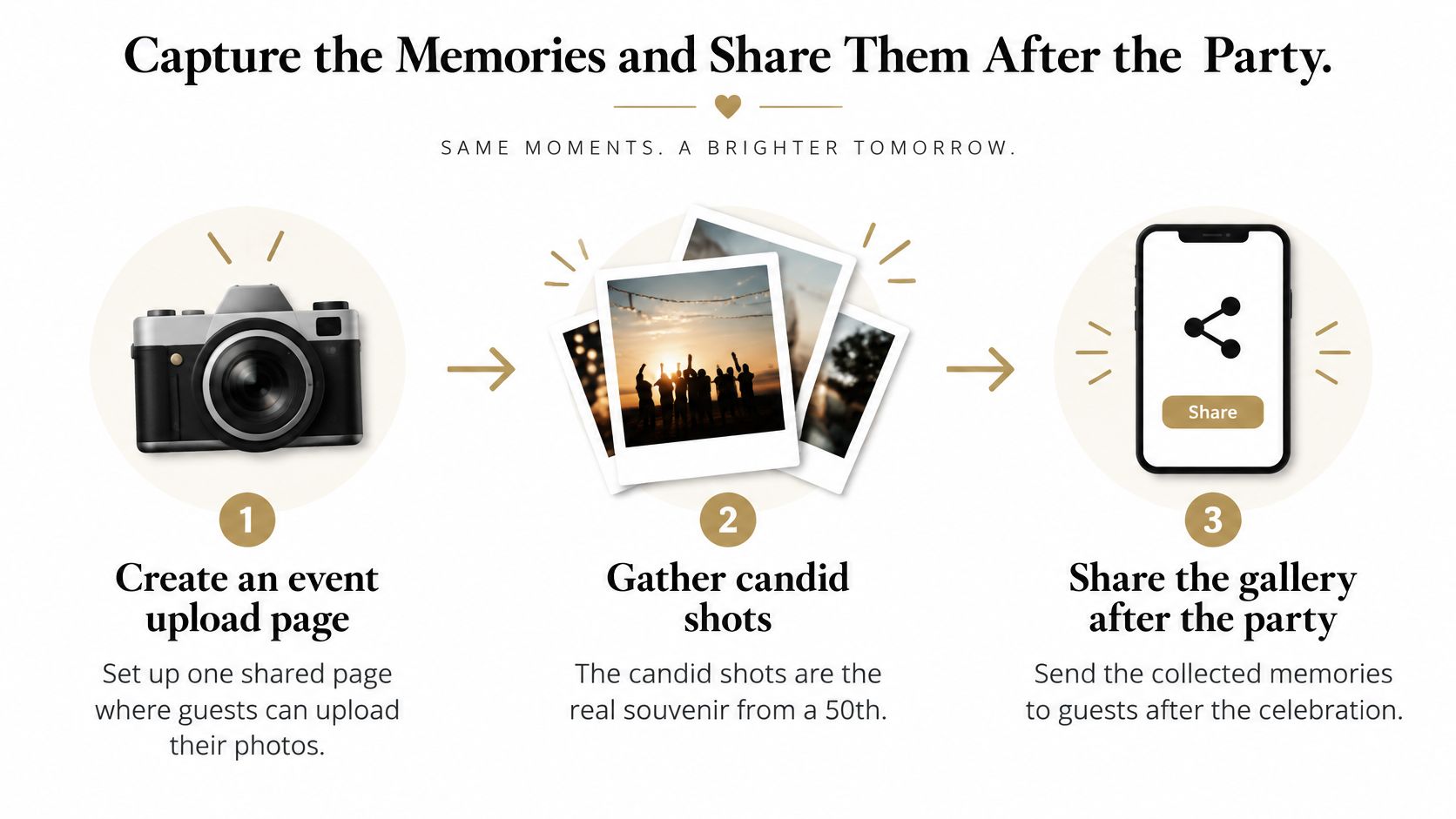
Here's the workflow I'd run, with EventUploader handling the collection side.
- Create one upload page. Party name, a short welcome message, your colors and logo. Setting up a first event takes under two minutes, so this isn't a project.
- Print the QR code at whatever size you need. Download it as a PNG for table cards, the bar top, the entrance sign and the invitation itself.
- Let guests upload with no app and no account. They scan with the phone camera, pick their shots and they're done. This is the part that matters for grandparents and colleagues who won't install anything.
- Watch uploads arrive during the party. One dashboard shows what's coming in, so you can nudge a quiet table or point someone at the sign. Uploads can be paused or closed once the night ends.
- Hand the gallery back afterward. Add names so guests can find themselves, group the best into as many albums as you like, and publish them on the same link everyone already used.
Two details make this work. Name a photo wrangler who isn't the host, so nobody has to choose between greeting guests and checking a screen. And pair the guest candids with a short professional session if you want clean portraits of the family together. The guide to which photos to share after an event covers the editing and selecting side once the uploads stop.
EventUploader gives you a branded upload page and a printable QR code so every guest can add photos and videos from their phone, with no app to download and no account to create, and you can publish the favorites to a gallery on the same link once the party is over. Set it up the same evening you fix your date and budget ceiling, and the rest of this plan has somewhere to land. Start with EventUploader.